
Review · KYOTO COOKING CLASSES
Kyoto: Ramen, Gyoza, and Onigiri Cooking Class
The clever part of this Kyoto cooking class is its focus on ramen broth, not homemade noodles. You learn how to turn easy-to-find ingredients into miso and shoyu soup, then use that broth with noodles you can buy at home. I like that the class also teaches two very useful Japanese basics: folding neat gyoza and shaping onigiri.
I also like the small class size and the practical pace. Instructors such as Nori, Kairi, Minori, and Aoi have been praised for clear English, good humor, and patient help. The main catch is food flexibility: vegan, pescatarian, gluten-free, and other special diets cannot be accommodated, and everyone must be at least 13 and able to cook independently.
Key points at a glance
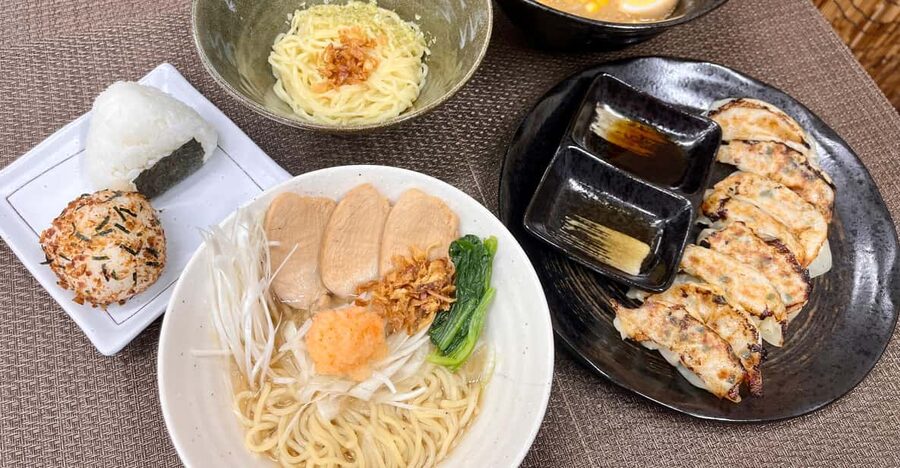
- Two ramen styles: Prepare miso and shoyu broths with familiar seasonings and simple toppings.
- Hands-on gyoza practice: Mix the filling, learn the fold, and pan-fry the dumplings yourself.
- Onigiri made by hand: Shape seasoned rice balls into a tidy snack or lunch.
- Small English-speaking class: The group is capped at eight, with some sessions attended by only two to four people.
- A filling 90 minutes: All food is included, and you eat what you make at the end.
- Strict menu limits: The vegetarian option replaces pork with tofu, but it is not vegan, pescatarian, or gluten-free.
Making Kyoto comfort food in 90 minutes
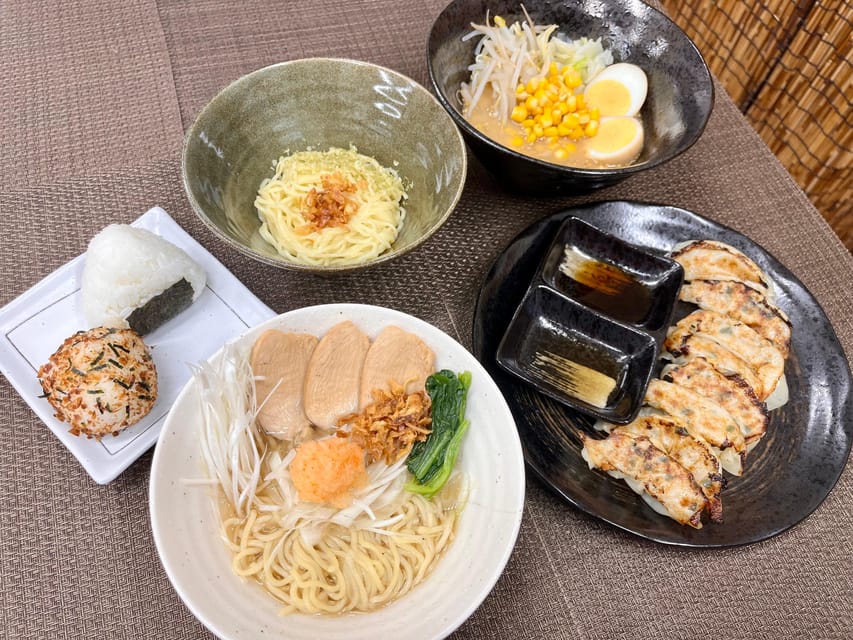
This is a compact cooking lesson with a generous menu. In about an hour and a half, you work on two kinds of ramen, gyoza, and onigiri, then sit down to eat the results. That sounds ambitious, but the preparation is organized to keep the class moving.
Ingredients are portioned ahead of time, and equipment is supplied. This means you are not spending half the lesson hunting for seasonings or measuring large quantities. The tradeoff is that the class is partly assembly and technique rather than a full professional kitchen lesson from raw ingredients.
That format suits you if you want useful skills without giving up half a day in Kyoto. It also makes the class friendly to families and first-time cooks. You still measure small amounts, combine ingredients, shape food, and cook it, but the work is arranged so you can concentrate on the parts worth taking home.
The pace can be quick. One participant described preparing both ramen styles, gyoza, and onigiri in roughly 60 minutes, while the official activity lasts 90 minutes. You should arrive ready to listen and work rather than expect a slow, leisurely demonstration.
More Sushi and Japanese Classes in Kyoto:
- Ramen Cooking Class at Ramen Factory in Kyoto
★ 5.0 · 1,937 reviews - Kyoto: Ramen Cooking Class at a Ramen Factory with Souvenir
★ 4.9 · 532 reviews - Kyoto: Japanese Washoku Bento Small Group Cooking Class
★ 5.0 · 380 reviews
Starting with miso and shoyu ramen broth
The ramen lesson centers on the soup. That is a smart choice because noodles are easy to buy in Japan and in many other countries, while a good broth is harder to recreate at home.
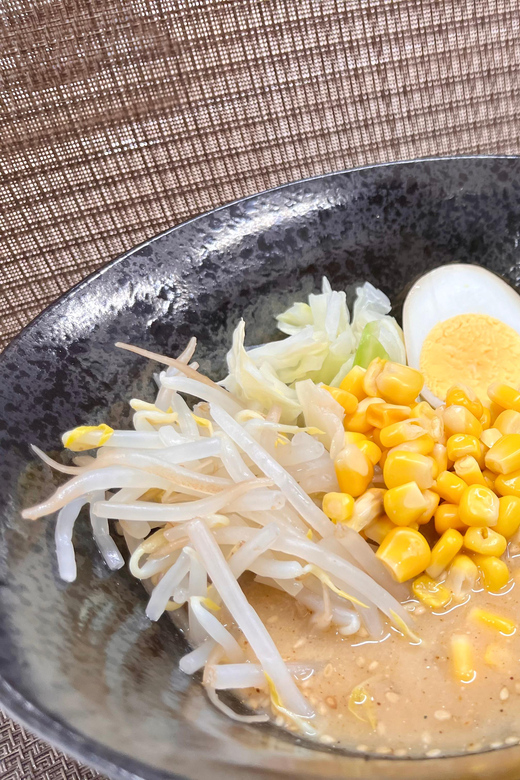
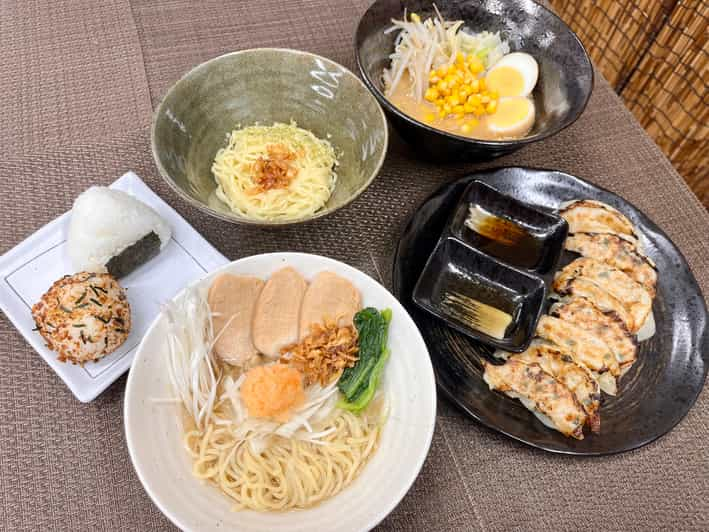
You prepare two styles: miso ramen and shoyu ramen. Miso gives the soup a savory, rounded flavor. Shoyu, based on soy sauce, brings a sharper salty depth. The class shows how broth, seasoning, and toppings need to support one another rather than compete.
The ingredient list is practical. It includes items such as chicken stock powder, soy sauce, miso, oyster sauce, sesame oil, garlic, ginger, mirin, cooking sake, fish powder, lard, butter, chili oil, and black pepper. Some of these ingredients are not suitable for every diet, so read the menu rules carefully before booking.
For miso ramen, the toppings include boiled egg, bean sprouts, green onions, and sweet corn. Shoyu ramen comes with chicken, bamboo shoots, and green vegetables. These are restrained toppings, and that is intentional. The broth carries the main flavor, while the toppings add texture, color, and balance.
I find this useful for home cooks. It is easy to pile on strong toppings and lose the character of the soup. Here, you learn that a few plain ingredients can work better than a crowded bowl.
The class does not teach you to make ramen noodles. That is not a weakness if your goal is to recreate the meal at home. You can buy noodles near home and apply the broth method right away. If you specifically want to knead and cut noodles, this is not the right class.
Folding gyoza without losing the filling
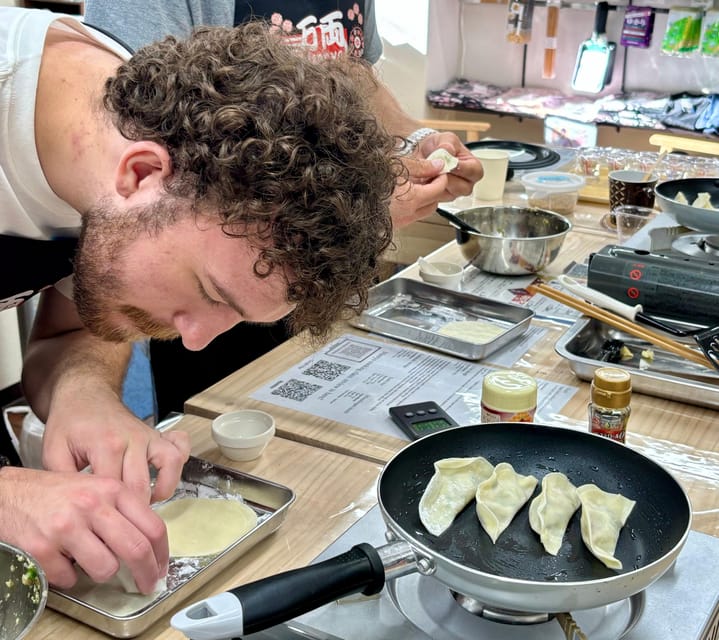
Gyoza is where the lesson becomes especially hands-on. You work with a filling based on ground pork, cabbage, onion, chives, garlic, ginger, seasonings, and other listed ingredients. The goal is to balance meat, vegetables, and seasoning, then seal each dumpling neatly.
The first few folds may look uneven. That is part of the fun. The instructors show you how to place the filling, moisten the wrapper, create the pleats, and press the edge closed. The class promises full instruction on the shape and seal, rather than simply handing you finished dumplings to cook.
The practical value is clear. Gyoza is the sort of food you can make for friends at home, and the technique improves with repetition. You leave knowing what a properly filled dumpling should feel like and how to keep it from opening in the pan.
The finished gyoza is pan-fried, giving it a crisp underside and tender top. Since you eat the food you prepare, you get an immediate lesson in how your folding and filling choices affected the result.
The vegetarian menu replaces pork with tofu. That may work for some vegetarians, but the other ingredients remain the same. In particular, the menu is not suitable for vegans, pescatarians, people avoiding gluten, or anyone with another special dietary need.
Shaping onigiri for an easy Japanese lunch
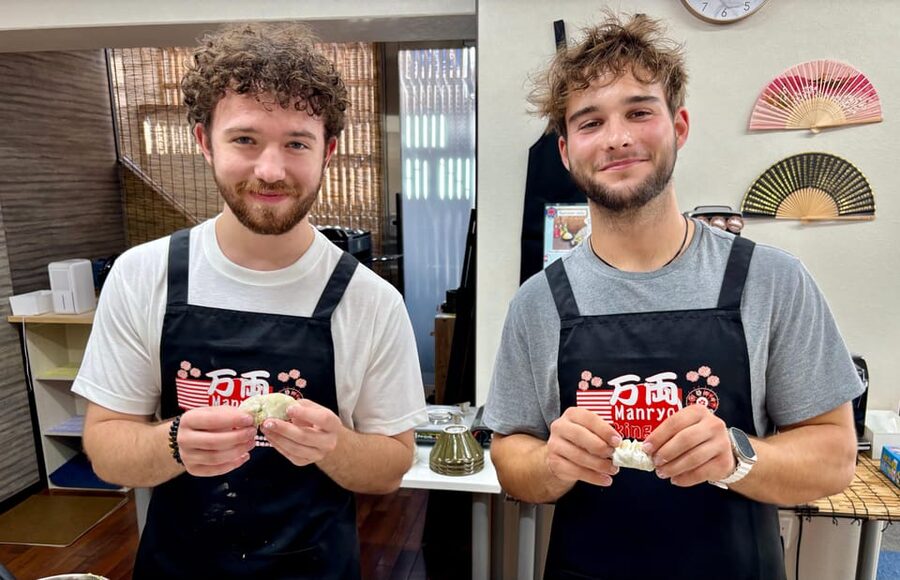
Onigiri is the simplest-looking dish on the table, but good shaping takes a little care. You form seasoned rice into compact rice balls, making them easy to hold and eat.
The class presents onigiri as a quick snack and a practical alternative to a sandwich. That makes it one of the most useful take-home ideas. Ramen and gyoza require more cooking, but onigiri can become part of an everyday lunch once you understand the basic shaping method.
You also get a nice contrast between the dishes. Ramen teaches broth and seasoning. Gyoza teaches filling, folding, and pan-frying. Onigiri teaches texture and hand technique. Together, they give you a broad introduction to Japanese home-style cooking rather than one narrow recipe.
The supplied details specifically promise recipes for ramen and gyoza. You should not assume that a printed onigiri recipe is included, although the instructors do teach the method during the class.
More Cooking Classes in Kyoto:
- Kyoto Ramen and Gyoza Cooking Class with Professional Chefs
★ 5.0 · 282 reviews - Kyoto: Afternoon Japanese Izakaya Cooking Class
★ 4.9 · 241 reviews - Izakaya Style Cooking Class
★ 5.0 · 219 reviews - Gyoza Cooking Class in Kyoto: Traditional Japanese Dumplings
★ 5.0 · 210 reviews
Friendly teaching in a group of eight or fewer
The class is limited to eight participants and taught in English. That small number matters because you are handling food at several stations and may need help with folds, measurements, or cooking order.
Names associated with the class include Nori, Kairi, Minori, Aoi, Ayuna, Riho, Mia, and Kiara. Nori is often singled out for humor and clear instruction, while the supporting teachers help keep the stations organized. Several sessions have had only two to four people, which allows more direct conversation and questions.
You can ask about cooking methods, ingredients, Japanese food customs, and even kitchen tools. One class participant used the chance to ask about Japanese knives, which gives you an idea of the broader conversation available in a small session.
The tone appears light rather than formal. The instructors explain the origin of the dishes and the role of different seasonings, then move you into the cooking. English speakers should find the class easy to follow.
Still, do not confuse friendly help with full one-to-one supervision. The maximum group is eight, and the class moves quickly. You must be able to cook by yourself without constant assistance. The stated minimum age is 13, even though some past families brought younger children. For planning purposes, follow the formal age rule.
What the food quantity means for your day
You should arrive hungry. The menu is not a tiny tasting session. You prepare two ramen bowls, gyoza, and onigiri, then eat the food at the end. Several people found the meal so filling that they could not finish everything.
That makes the class useful as a late morning lunch or an afternoon meal. It can also work as an early evening activity, provided you do not plan a large dinner right afterward.
Coffee and tea are included. Beer may be available for purchase after the meal, but it is not part of the included package. Do not count on alcohol as part of the experience.
The food you make is included in the $90 price. That price is not cheap for a 90-minute activity, but it covers the instruction, ingredients, equipment, meal, drinks, and recipes for ramen and gyoza. You are also paying for a small class rather than a large demonstration where you simply watch.
I would judge the value by your goal. If you want a relaxed food tour with many restaurant stops, spend the money elsewhere. If you want a short, social lesson that leaves you able to repeat the dishes at home, the price is easier to justify.
Finding the classroom near Sanjo Keihan
The classroom is in the basement level, B1, of the Life Building. It is not on the main street, and the entrance can be easy to miss if you are rushing.
Search Google Maps for Manryo cooking class before leaving. If you arrive by taxi, the suggested landmark is the Family Mart at Sanjo Keihan. From there, the classroom is about a two-minute walk.
I would allow extra time. One participant found the location tucked into a small side street, and the instructions specifically ask you to check the map in advance. Arriving around 10 minutes early is sensible, especially if this is your first visit to the area.
Hotel pickup and drop-off are not included. You make your own way to the classroom.
Wear comfortable clothes and shoes. You will be standing, handling ingredients, and moving through several cooking steps, so this is not the place for restrictive clothing or uncomfortable footwear.
Dietary rules you should read before paying
The dietary policy is the biggest limitation. Only two menu choices are offered:
- Regular menu
- Vegetarian menu, with pork replaced by tofu
The vegetarian choice does not mean plant-based. Other ingredients remain the same, so it is not suitable for vegans or pescatarians. The class also cannot accommodate gluten-free diets or other special food requirements.
This matters because the ingredient list includes oyster sauce, fish powder, chicken stock powder, lard, cooking sake, and other products that may conflict with personal or medical restrictions. Contacting the provider to request changes is not a safe assumption, since the published rules say special diets cannot be accommodated.
The experience is also not suitable for wheelchair users or people with recent surgeries. The classroom is in a basement location, and the class requires independent cooking. These are practical reasons to choose another activity if mobility or recovery is a concern.
Who will get the most from this Kyoto cooking class?
I would recommend it most strongly to adults, teenagers aged 13 and older, couples, friends, and families who enjoy doing rather than watching. It is also a good fit if you want recipes that feel possible in an ordinary home kitchen.
The class works especially well for:
- First-time Japanese cooks who want a clear introduction
- Ramen fans interested in broth rather than noodle production
- Families with teenagers who can work independently
- Couples looking for a shared activity near central Kyoto
- Home cooks who want to host a future gyoza meal
It is less suitable if you want advanced knife skills, homemade noodles, a slow chef demonstration, or a menu built around your dietary needs.
The class can also be a useful rainy-day plan. The food, equipment, and teaching are all in one indoor activity, and the 90-minute length leaves room for other Kyoto plans.
Should you book the ramen, gyoza, and onigiri class?
Book it if you want a practical, food-centered activity with a small group, clear English instruction, and plenty to eat. The strongest features are the two broths, the gyoza folding practice, and the chance to make food you can repeat at home.
Before booking, confirm three things: everyone meets the age requirement, everyone can cook independently, and the regular or vegetarian menu fits your diet. Also check the map carefully and arrive early for the B1 classroom.
At $90, this is best viewed as a compact cooking lesson plus a substantial meal, not a cheap lunch. For people who enjoy Japanese food and want more than a restaurant table, it is a sensible Kyoto choice. For strict dietary needs or anyone hoping to make noodles from scratch, choose another class.
FAQ
How long does the Kyoto cooking class last?
The class lasts 90 minutes. Starting times vary, so you need to check availability when booking.
What dishes will I make?
You will make miso ramen, shoyu ramen, gyoza, and onigiri. The ramen lesson focuses on preparing broth rather than making noodles.
Are ramen noodles made during the class?
No. The class teaches you how to prepare the ramen broth, while the noodles are sourced separately. This is meant to make the recipes easier to repeat at home.
Is the class suitable for vegetarians?
A vegetarian menu is offered, with pork replaced by tofu. Other ingredients remain the same, so the menu is not vegan or pescatarian.
Can the class accommodate gluten-free or other special diets?
No. Gluten-free, vegan, pescatarian, and other special dietary requests cannot be accommodated.
Where is the cooking class located?
The classroom is in B1 of the Life Building. It is one street away from the main road. From the Family Mart at Sanjo Keihan, it takes about two minutes on foot. Search for Manryo cooking class on Google Maps before arriving.
Newest classes around Kyoto
- Kyoto Udon & Tempura Cooking Class with Professional Chefs★ 3.8 · 3 reviews
- Kyoto: Wagashi (Japanese sweets) Cooking near Fushimiinari★ 5.0 · 40 reviews
- Kyoto Home Cooking Class &Supermarket tour near Fushimiinari★ 5.0 · 31 reviews
- Kyoto: Morning Japanese Bento Cooking Class★ 5.0 · 149 reviews
- Kyoto: Authentic Sushi Making Cooking Lesson★ 5.0 · 103 reviews
- Kyoto: Cooking class, learning how to make authentic sushi★ 4.2 · 9 reviews
- Authentic Japanese Cooking Experience at Izakaya restaurant★ 4.2 · 5 reviews
- Gyoza Cooking Class in Kyoto: Traditional Japanese Dumplings★ 5.0 · 12 reviews
Kyoto Cooking Classes, compared.
Ramen Cooking Class at Ramen Factory in Kyoto
Read our review →
Ramen Cooking Class at a Ramen Factory with Souvenir
Read our review →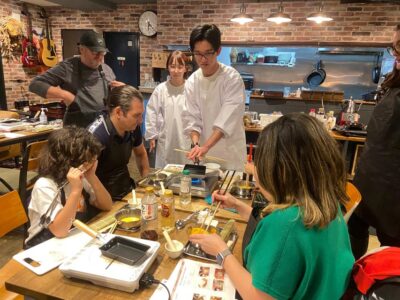
Japanese Washoku Bento Small Group Cooking Class
Read our review →
Kyoto Ramen and Gyoza Cooking Class with Professional Chefs
Read our review →

Gyoza Cooking Class in Kyoto: Traditional Japanese Dumplings
Read our review →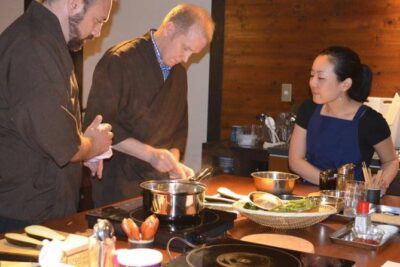
Browse the lists this tour appears in