Review · UBUD COOKING CLASSES
Balinese Ubud cooking school (9 Dish Cooking and Market Tour)
The best part of this Ubud experience is its range: in about five hours, you visit a local market, see rice paddies, and prepare nine Balinese dishes rather than stopping after one curry and a plate of rice. The class is held at a Balinese home, which gives the day a more personal feel than a polished hotel kitchen.
I like the market stop, where you can try unfamiliar fruits, cakes, vegetables, and spices with a local guide. I also like the generous menu, especially the chance to make sambal matah, sate lilit, pepes, lawar, and klepon in one sitting. The main drawback is the transport: the school can be roughly 50 minutes from central Ubud, and pickup rules are stricter than the broad wording may suggest.
Key points before you book
- Nine dishes in one class: Prepare a full Balinese menu, including soup, sambal, sate, vegetables, a main dish, and dessert.
- Morning means market and rice paddies: The morning option includes a local market visit and a stop in the rice fields.
- Afternoon has a different cultural stop: The afternoon option includes making a Balinese offering instead of the traditional market visit.
- Choose meat or vegetarian food: The regular menu uses chicken, while the vegetarian menu substitutes tofu and tempeh.
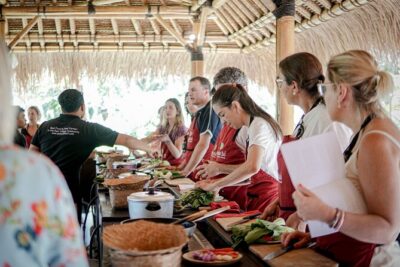
- Small group setting: The class accepts up to 14 people, with cooking stations arranged so you can take part.
- Transport needs checking: Ubud pickup and drop-off are included, but trips from outside Ubud may cost extra and must be arranged in advance.
What the five-hour Ubud cooking day is really like
This is not just a cooking lesson. It is a half-day look at how food connects with markets, rice farming, household life, religion, and family meals in Bali.
The morning program begins at Ubud Palace, where the driver or guide collects you. From there, the trip heads away from the center toward a local market and the cooking school. The exact order can vary, but you should allow much of the morning for transport and sightseeing before you sit at the stove.
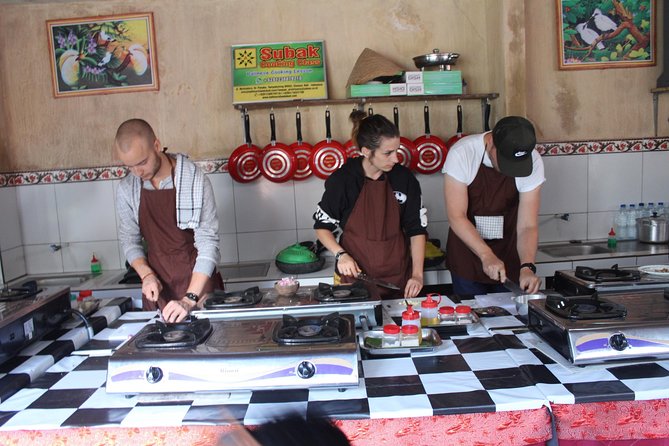
The school takes a maximum of 14 people. That is not an intimate private lesson, but it is small enough for a shared class to work well. Past participants describe cooking in pairs or around one large table, with individual stoves or work areas. The staff prepare some ingredients in advance, so you can get through a long menu without spending the whole day chopping.
That setup has two sides. You will not handle every raw ingredient from start to finish, but you will have time to prepare and cook the important parts of each recipe. If your main goal is to make as many dishes as possible, the advance preparation is useful. If you want a slow, highly technical lesson on knife work and kitchen technique, this class may feel too brisk.
More Cooking Classes with a Market Tour in Indonesia
- Ubud: Cooking Class with Transfers and Optional Market Visit
★ 4.9 · 824 reviews - Ubud: Balinese Cooking Class and Market Tour
★ 4.8 · 531 reviews - Balinese Cooking class with traditional morning market visit
★ 5.0 · 161 reviews
The morning market: fruit, spices, sweets, and daily life
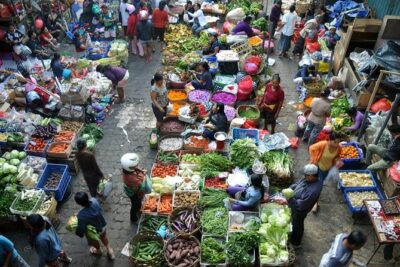
Choose the morning session if the market matters to you. This is the option that includes a visit to a traditional market, where your guide explains how local people buy and sell food.
You may see vegetables, spices, cakes, fruit, and ingredients used in Balinese home cooking. The experience also includes tasting local produce, including fruits that may be unfamiliar to you. One useful detail is that the guide does not only point out ingredients. You also learn something about how market buying works and how the food connects to the cooking lesson later in the day.
The market is likely to be most useful for curious eaters rather than serious shoppers. You are there to learn and taste, not to fill a suitcase with ingredients. Guides such as Wayan and Tata have been praised for explaining food, religion, local customs, and everyday life in clear English. The exact host may differ, but the local guide is an important part of the experience.
The market can also be visually and physically busy. If you prefer quiet sightseeing, this stop may feel like a lot at once. Bring comfortable clothes, your camera, and some cash for extra transport charges if you are staying outside Ubud. The market visit is only offered with the morning class, so select your session carefully.
Rice paddies and a glimpse beyond central Ubud
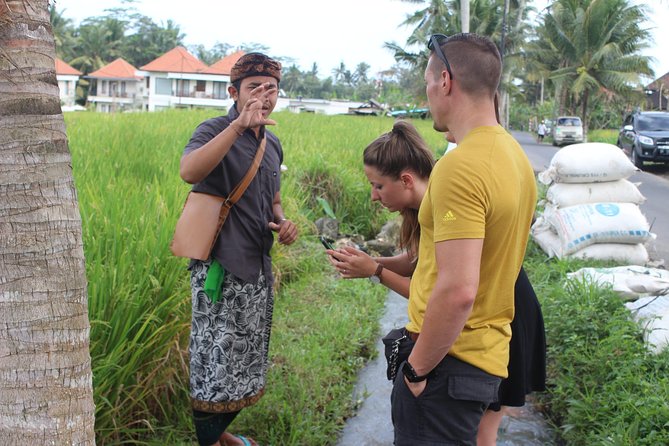
The morning itinerary also includes a stop at rice paddies. This is a short cultural and scenic break, not a full farming lesson, but it adds context to the meal you are about to cook.
You can learn about rice growing in Bali, the different kinds of rice, and how long it takes before a crop is ready to harvest. Depending on the route, you may also get views toward a volcano in the distance. The stop helps explain why rice is not just a side dish in Bali. It is part of farming, food, ritual, and daily routine.
The rice field visit is also one reason the trip takes longer than a simple class in central Ubud. Some people will enjoy the extra local context. Others may find the driving time excessive, especially if they expected pickup directly from a Ubud hotel and a school close to town.
The published meeting point is Ubud Palace. Pickup and drop-off are offered in the Ubud area, but if you stay farther out, extra charges apply. Confirm the arrangement before you go. Do not assume that a hotel pickup outside Ubud is included.
Afternoon alternative: making a Balinese offering
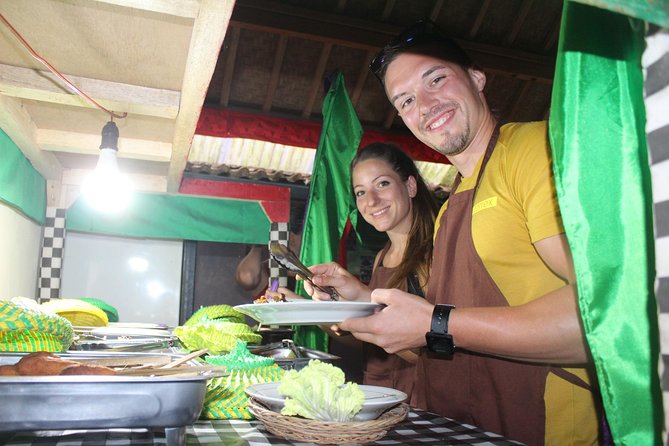
The afternoon program does not include the traditional market visit. Instead, it includes making a Balinese offering.
That is a worthwhile choice if you have already seen a market elsewhere or want a cultural activity tied to Balinese religious practice. It also makes the afternoon class different rather than simply repeating the morning schedule at a later hour.
The supplied details do not give a full step-by-step description of the offering activity, so I would not book the afternoon expecting the same market and rice-field route. Choose the morning class for food shopping and rice farming. Choose the afternoon class if making an offering is the more appealing cultural experience.
More Cooking Classes with a Market Tour in Ubud
- PRIVATE Ubud Market Tour & Balinese Cooking Class with Putu
★ 5.0 · 125 reviews - Jambangan bali cooking class with morning market tour
★ 5.0 · 35 reviews - Balinese cooking class/Go shopping at the market, cook, eat
★ 5.0 · 12 reviews
Cooking nine Balinese dishes, one station at a time
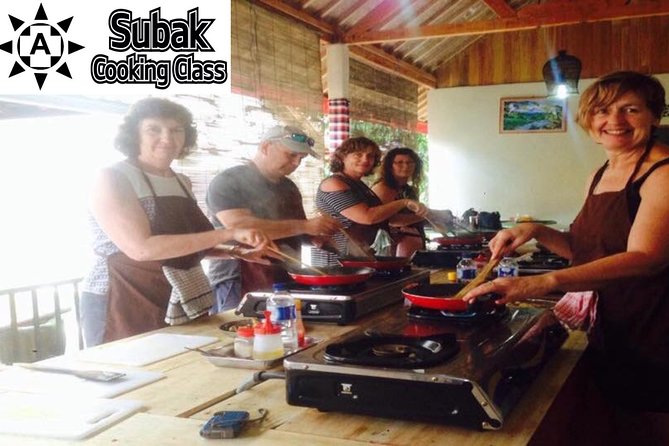
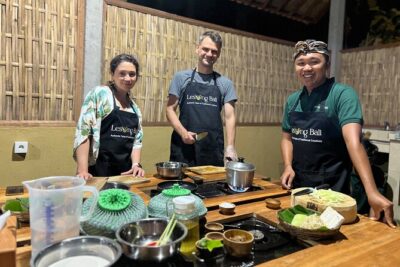
The cooking lesson is the heart of the day. A Balinese chef leads you through the preparation step by step, while kitchen staff help keep the class moving.
The regular menu includes:
- Balinese vegetable soup
- Chicken with coconut milk and Balinese spices
- Sweet fried tempeh
- Chicken sate lilit
- Chicken pepes cooked or grilled in banana leaf
- Lawar, a mixed vegetable dish with Balinese spices
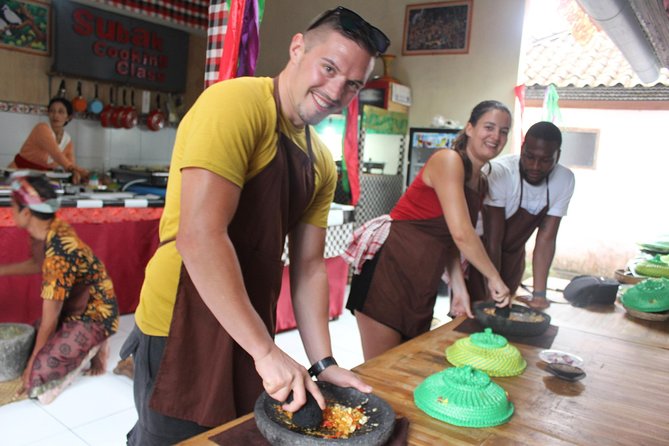
- Sambal matah, a raw spice mixture with coconut oil
- Base gede, the basic Balinese spice paste
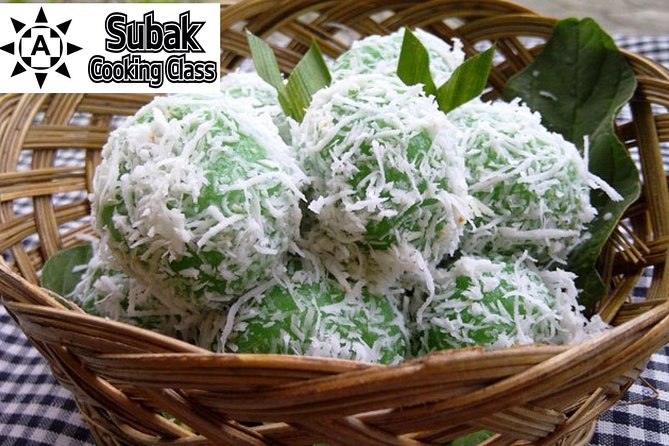
- Klepon, a sticky rice-flour cake with palm sugar
The main dishes are served with white rice. You cook enough food for a full meal, not just a small sample. Several people have found the portions so generous that they could not finish everything and were allowed to pack some food for later.
I especially like the menu design. You learn several different cooking methods in one class: boiling, frying, grilling, steaming, mixing raw ingredients, grinding spice paste, and making a sweet. Base gede is particularly useful because it forms the foundation of many Balinese dishes. Sambal matah teaches a different lesson, since it is fresh and uncooked rather than simmered into a sauce.
Sate lilit is another good choice for a class. Instead of simply threading chunks of meat onto a skewer, you shape seasoned meat around the skewer. Pepes introduces banana-leaf cooking, a method that gives the dish a distinct presentation and keeps the food moist.
The menu is extensive, so the class is about practical home cooking rather than restaurant-level precision. You will learn the order of preparation, how the spice mixes work, and how the finished dishes fit together. You should not expect to make every component entirely from scratch without help.
Vegetarian cooking is a proper menu, not an afterthought
You must select either the regular or vegetarian menu when booking. The vegetarian option is built around tofu and tempeh rather than simply removing chicken from the regular dishes.
It includes vegetable soup, tofu with Balinese spice sauce, sweet fried tempeh, tempeh sate with peanut sauce, tofu pepes in banana leaf, lawar, sambal matah, base gede, klepon, and white rice.
That is a strong option for people who want a complete meal and not a plate of side dishes. Tofu and tempeh also work well for learning Balinese spice combinations because they absorb sauces and seasonings.
Tell the provider your preference clearly when you reserve. The class can adapt well to meat and vegetarian choices, but the menu needs to be organized ahead of time.
The teachers make the difference
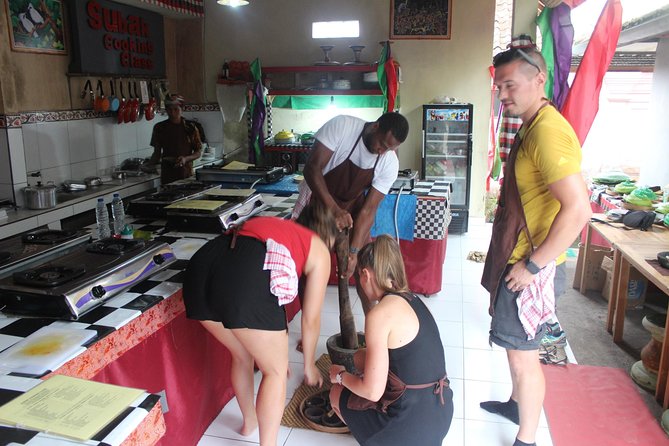
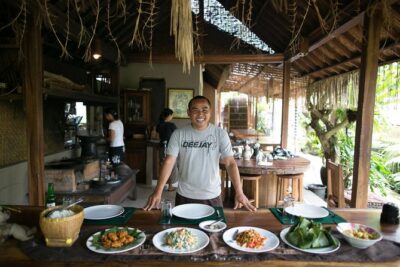
The food matters, but the teaching style will shape your day. The class has been led by hosts and cooks including Yogi, Putu, Gus, and others, with drivers such as Tata and Harry mentioned by name in personal accounts. You may not have the same instructor, but the recurring pattern is a friendly, humorous teaching style with clear demonstrations.
Yogi, in particular, has been praised for keeping the class lively while explaining each stage carefully. That matters because nine dishes can become confusing if the instructions are rushed. A good teacher helps you understand which ingredients belong together and when each pan needs attention.
English ability has generally been strong enough for explanations about ingredients, cooking, culture, and religion. Still, a group class can get noisy, especially when kitchen staff are talking while several dishes cook at once. One dissatisfied participant found it hard to hear and felt that too much preparation had been done before the class.
I would sit close to the instructor if hearing is important to you. Ask questions as you go, and do not be shy about requesting a demonstration again. The class is designed for beginners, so you do not need previous cooking experience.
Eating what you made at the end
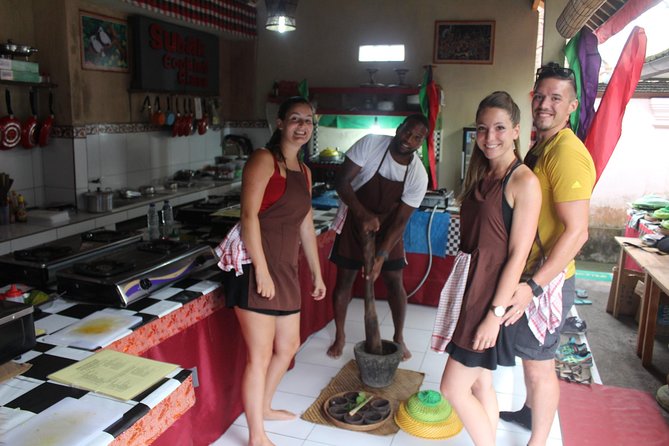
After the cooking, everyone sits down to eat the meal. This is a buffet-style lunch or dinner made from the dishes prepared during the lesson.
The meal gives you a useful comparison point. You can taste how the soup, spice paste, raw sambal, lawar, sate, banana-leaf dish, and dessert work together. You can also ask about adjusting heat levels. Several people prepared milder versions successfully, while others enjoyed the stronger spice.
If you are not used to large meals, arrive hungry. The menu is long, and you may want to try everything. Leftovers can sometimes be packed to take back to your hotel, although you should see this as a courtesy rather than a guaranteed takeaway service.
Mineral water is included. Alcoholic drinks are not included, so bring your own budget if you want something beyond water.
Is $58 a fair price?
At $58, this is not the cheapest cooking lesson in Bali. The value depends on how much of the full outing you use.
You are paying for roughly five hours, a local guide, transport within Ubud, the market or offering activity, the rice-field stop on the morning option, cooking equipment, ingredients, food tasting, and a substantial meal. You also receive recipe copies so you can try the dishes at home.
Compared with a short class that teaches two or three dishes, nine recipes give this experience a stronger food value. You also avoid buying specialty equipment and ingredients for a one-off lesson. For a couple or family that wants a full cultural and food activity, the price is reasonable.
The value drops if you are staying far outside Ubud and face added transport charges. It also drops if you mainly want a technical cooking lesson and have little interest in the market, rice paddies, or cultural stops.
The listed price is also higher than one older personal account that referred to paying $25. Treat that older figure as historical, not as a price you should expect now.
Practical details that can save you trouble
The activity starts and ends at Ubud Palace unless another pickup arrangement is confirmed. Show your booking reservation when you meet the provider.
Wear normal, comfortable clothing. Bring a camera if you want pictures of the market and rice fields. If you stay outside Ubud, carry cash for any agreed transport supplement. One past complaint involved a long transfer and confusion over an extra toll charge, so confirm the pickup point, travel time, and added costs before departure.
The school offers free cancellation if you cancel at least 24 hours before the start time. Cancellations or changes made within 24 hours are not refunded or accepted.
Who should book this cooking class?
I would choose this for food-focused families, couples, first-time visitors to Bali, and anyone who wants more than a standard demonstration. The broad menu keeps children and mixed-age groups involved, and the finished meal gives everyone a clear reward at the end.
It also suits vegetarians well because the alternative menu is planned as a full set of dishes. Beginners are welcome, and the instructors guide you through each stage.
I would be more cautious if you dislike long drives, crowded markets, large meals, or group instruction. If you want a quiet private lesson in central Ubud, this is not the safest choice. You should also confirm transport if you are staying in Nusa Dua or another area outside Ubud.
Should you book the Ubud nine-dish class?
Book it if you want a full half-day built around food, local culture, and a generous meal. The best features are the nine-dish menu, the market visit on the morning option, the chance to make Balinese spice paste and banana-leaf dishes, and the friendly instructors.
Choose the morning session for the strongest all-around program. Pick the afternoon session only if making a Balinese offering appeals more than visiting the market and rice paddies.
I would confirm the pickup details before paying, arrive hungry, and expect some ingredients to be prepared in advance. With those points clear, this is a good-value introduction to Balinese home cooking, especially for anyone who wants recipes they can actually try after returning home.
FAQ
How long does the Balinese cooking class last?
The experience lasts approximately five hours, including the cultural stops, cooking lesson, and meal.
Where does the tour start and end?
The listed meeting point is Ubud Palace at F7V7+72R, Jl. Raya Ubud No. 8. The activity ends back at the meeting point.
Is pickup included?
Pickup and drop-off are included for the Ubud area. If you stay outside Ubud, additional charges apply, and you need to request the arrangement in advance.
Does every session include a traditional market visit?
No. The traditional market visit is offered only with the morning class. The afternoon option includes making a Balinese offering instead.
Can I choose a vegetarian menu?
Yes. You can choose a vegetarian menu with tofu and tempeh dishes, including tofu with Balinese spices, tempeh sate, tofu pepes, lawar, sambal matah, base gede, klepon, and rice.
How many dishes will I prepare?
The class teaches nine Balinese recipes. The regular menu includes chicken, sate lilit, pepes, lawar, sambal matah, base gede, soup, tempeh, and klepon. The vegetarian menu replaces the chicken dishes with tofu and tempeh preparations.
What happens if I need to cancel?
You can receive a full refund if you cancel at least 24 hours before the experience begins. Cancellations or changes made less than 24 hours before the start time are not accepted for a refund.
More Balinese and Indonesian Classes in Ubud
- Ubud Cooking Class Bali with Balinese Chef
★ 5.0 · 1,609 reviews - PRIVATE Authentic Balinese Cooking Class in Ubud at Putu’s Home
★ 5.0 · 644 reviews - Balinese Farm Cooking Class by Pemulan Bali
★ 5.0 · 410 reviews - Balinese Authentic Cooking Class in Ubud
★ 5.0 · 239 reviews
Newest classes around Ubud
- The Authentic Balinese Cooking Experience★ 5.0 · 4 reviews
- Ubud: Organic Farm Harvest, Bali Cooking Class by Pemulan★ 4.8 · 12 reviews
- packages cooking class and romantic dinner in a local home★ 5.0 · 4 reviews
- Jambangan bali cooking class with morning market tour★ 5.0 · 35 reviews
- Ubud: Balinese Cooking Class with Hotel Transfers★ 4.8 · 17 reviews
- Balinese cooking class/Go shopping at the market, cook, eat★ 5.0 · 12 reviews
- Bali: Cooking Class with Monkey Forest and Art Village Tour★ 5.0 · 2 reviews
- PRIVATE Ubud Market Tour & Balinese Cooking Class with Putu★ 5.0 · 125 reviews
Ubud Cooking Classes, compared.
Cooking Class with Transfers and Optional Market Visit
Read our review →
PRIVATE Authentic Balinese Cooking Class in Ubud at Putu’s Home
Read our review →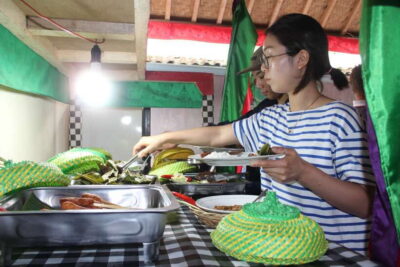
PRIVATE Balinese Cooking Class in Ubud with Dewa with Transfers
Read our review →