
Review · PARIS COOKING CLASSES
Paris: Croissant Baking Class with a Chef
The best part of this Paris class is that you do not simply watch a chef fold dough. You roll, cut, shape, and bake your own pastries, with Chef Leo or Chef Maria correcting your technique as you work. I like the small group of eight and the way the class explains the science behind butter, resting, and proofing rather than treating croissants like magic.
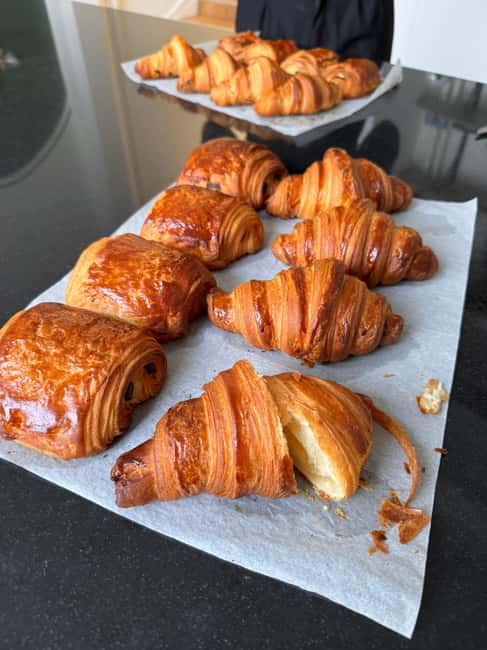
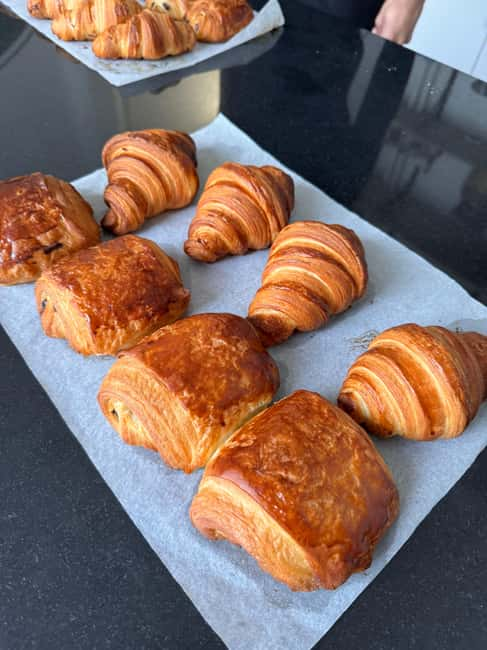
I also like the generous result: many sessions produce four butter croissants and four pain au chocolat per person, enough to enjoy one hot in class and carry several back to your hotel. The main consideration is physical effort. Rolling laminated dough takes arm strength, and the class is not suitable for children under 15.
Key points to know before booking
- Hands-on from start to finish: You handle the dough at each important stage instead of watching a demonstration from the side.
- Chef Leo or Chef Maria teaches in English: Both chefs are described as friendly, lively, patient, and clear with beginners.
- Small class, personal help: With no more than eight participants, the chef can check your folds, shaping, and technique.
- You usually make two French classics: The standard class includes butter croissants and pain au chocolat, while selected dates may offer bi-colour croissants.
- A useful Paris souvenir: You receive a recipe and leave with freshly baked pastries you made yourself.
- Central, easy-to-reach meeting point: Studio Pâtisserie has a gray storefront near Metro Line 2 at Rome and Line 3 at Villiers.
Why this class is more than a pastry demonstration
Paris has no shortage of pastry shops, so a croissant class needs to offer more than a good photo and a quick taste. This one earns its place on an itinerary because you learn the difficult parts yourself: working the dough, keeping the butter in place, folding cleanly, and shaping the crescents.
That hands-on format matters. Croissant dough can look simple on paper, but the result depends on small choices. The butter must be good quality. The dough needs time to rest. The folds need to create layers without crushing them. Proofing must go far enough to make the pastry light, but not so far that it loses structure.
Chef Leo and Chef Maria keep the lesson practical. They explain what to do, then watch you do it. If your dough needs more rolling or your shape is not quite right, you can ask for help before the pastry reaches the oven. That personal correction is hard to get in a large demonstration class.
The tone also seems relaxed rather than stiff. Chef Leo is often described as funny, energetic, and generous with individual attention. Chef Maria brings a similar warmth, with humor woven into the lesson. That helps if you are a first-time baker, or if your partner or family member has never touched laminated dough before.
More Baking Classes in France
- Paris Croissant Small-Group Baking Class with a Chef
★ 5.0 · 910 reviews - Paris: French Croissant Baking Class with a Chef
★ 4.9 · 712 reviews - Paris Macarons Small-Group Baking Class with a Chef
★ 5.0 · 316 reviews
Arriving at Studio Pâtisserie near Rome and Villiers
The meeting point is Studio Pâtisserie, a building with a gray-colored storefront in the Ile-de-France region of Paris. Use the storefront description carefully, since a cooking class is easier to miss than a bright bakery sign.
The nearest Metro options are Rome on Line 2 and Villiers on Line 3. That gives you two useful routes from central Paris, although you should check the exact class start time and allow enough time to find the entrance. You do not want to arrive breathless just before the first butter fold.
Once inside, you work in a professional-grade kitchen with the ingredients and tools supplied. You do not need to shop for flour, butter, chocolate, or special equipment before arriving. The setting is described as clean, comfortable, and well suited to a small group.
The class lasts three hours. That may sound long for a pastry lesson, but croissant dough needs pauses. Resting and rising are part of the process, not wasted time. The breaks give the chef room to explain the reasons behind each step and give you a chance to ask questions.
Mixing, rolling, and learning the logic of the dough
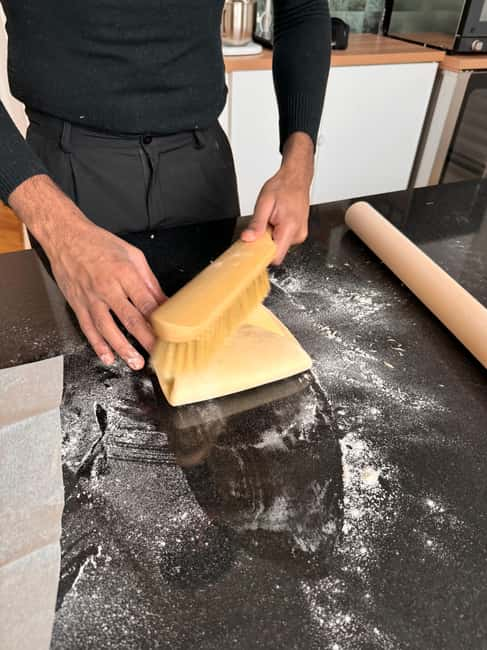
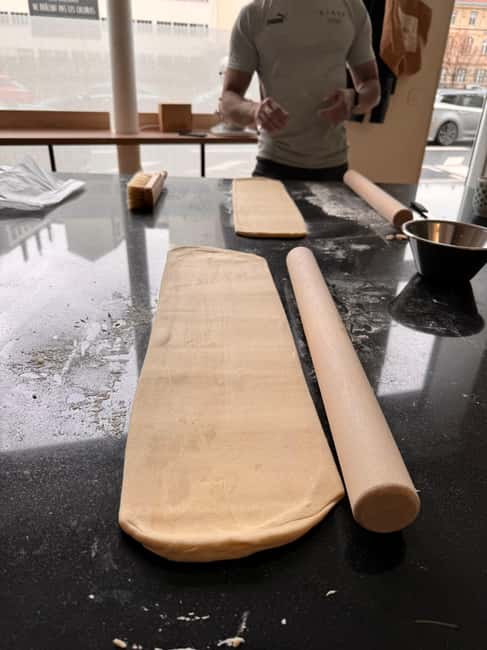
The class begins with the dough. The chef takes you through the basic preparation, then moves into the work that determines the final texture. You will knead and roll, and you should expect to use some strength.
This is the point where the age rule makes sense. Children under 15 cannot take the class, and anyone under 17 must be accompanied by a paying adult. The restrictions are not about the subject matter. Rolling croissant dough is a physical task, especially when the dough resists the rolling pin.
You also learn why the dough must rest between stages. A rushed dough is harder to handle and less likely to produce neat, airy layers. The chef uses the resting periods to discuss butter quality, proofing, texture, and flavor. You come away with more than a list of ingredients because you understand what each stage is trying to achieve.
I particularly value this balance between theory and practice. A recipe may tell you to fold, chill, roll, and fold again, but it rarely tells you what the dough should feel like. A chef standing beside you can point out whether it needs more work or more time.
Folding butter into flaky layers
Laminating is the technical heart of a croissant class. You fold the dough around butter, then roll and fold it to create thin layers. If the butter is too hard, it can crack. If it is too soft, it can disappear into the dough. Either problem can spoil the final texture.
This is where the eight-person limit pays off. The chef can move around the workstations and look at each person’s dough. You are not left guessing if your rectangle is uneven or your fold is off-center.
Do not expect the process to be effortless. The class is friendly to beginners, but beginner-friendly does not mean hands-free. You will work. Still, the instruction turns a tricky task into a series of manageable ones, and the chef can show you how to correct mistakes before they become permanent.
The pauses between folds also make the three-hour schedule feel sensible. You are not standing around waiting for a single batch to bake. Instead, you shift between practical work, questions, and explanations about the pastry’s history and method.
More Baking Classes in Paris
- Paris: Macaron Baking Class for Families and Kids
★ 4.7 · 270 reviews - Paris: Macaron Baking Class in Central Paris
★ 5.0 · 208 reviews - Paris French Baking Class Baguettes and Croissants in a Bakery
★ 4.5 · 172 reviews - Croissant Baking Class, Mastering the Art with a Pastry Chef
★ 5.0 · 116 reviews
Shaping butter croissants and pain au chocolat
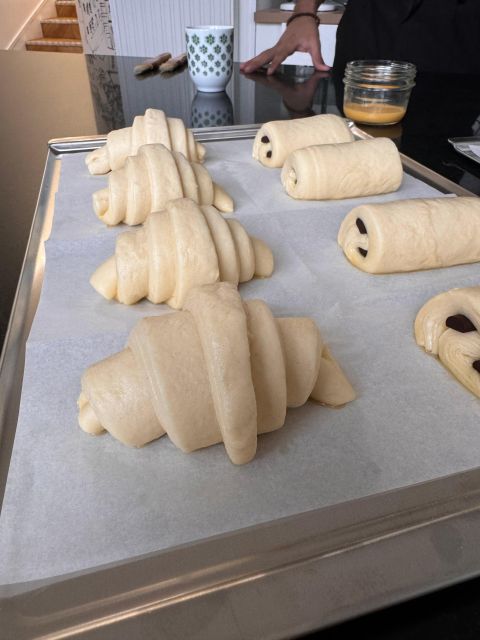
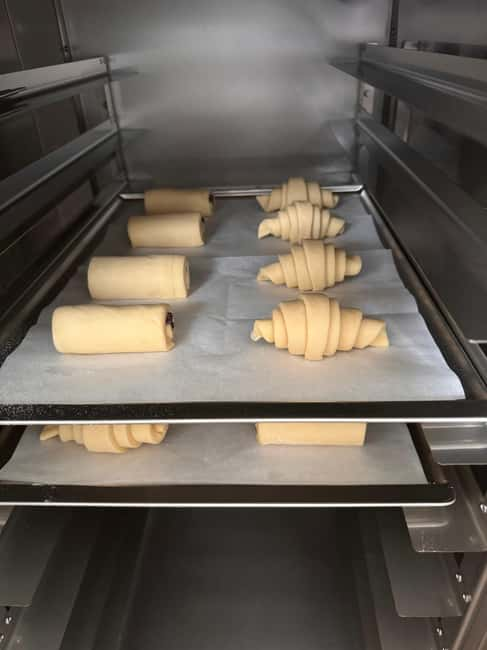
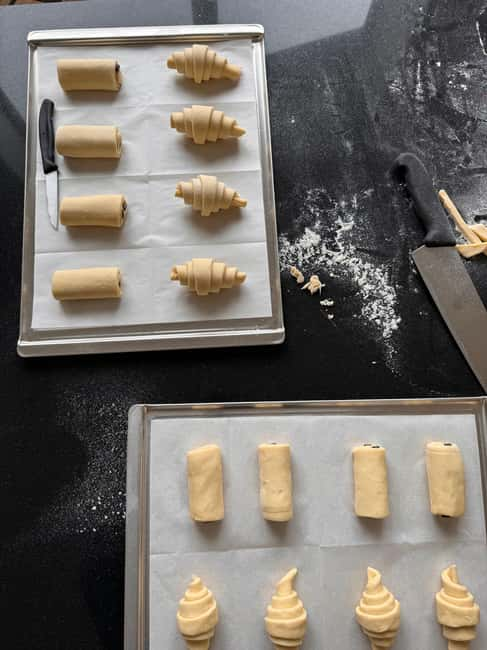
Once the dough is ready, you cut it into pieces and shape the pastries. Classic croissants require careful rolling into crescents, while pain au chocolat uses chocolate inside the dough and a different final shape.
Several classes have included four butter croissants and four pain au chocolat per person. That is a substantial amount of pastry. You will likely want to plan ahead for carrying some back to your hotel, especially if you book the class early in your Paris stay.
The shaping stage is satisfying because your work finally looks like a recognizable French pastry. It is also a useful test of what you have learned. Dough that was rolled evenly will shape more neatly, and careful handling helps keep the layers intact.
Chef guidance remains important here. Small adjustments can make a big difference to the finished appearance. You may get tips on how tightly to roll, where to place the chocolate, or how to give the croissant its crescent form.
The class may also offer a bi-colour croissant option on selected days. This version adds colored dough to the pastry, giving it a more decorative finish. Check the available option when booking if that is the style you want, since it is not presented as the standard format for every session.
Proofing, baking, and the warm reward
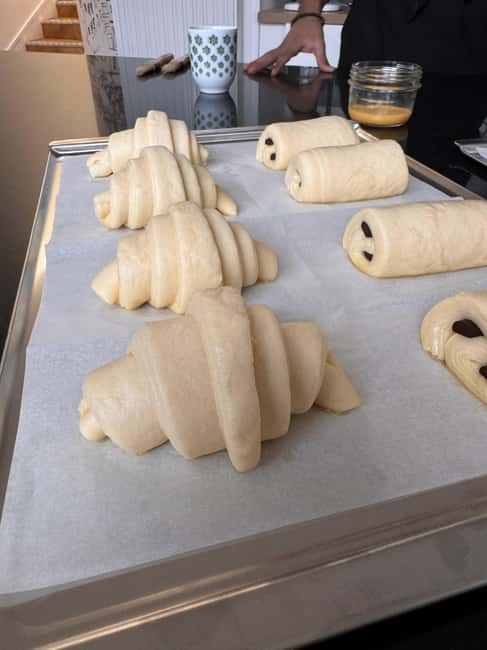
After shaping, the pastries need to proof before baking. This is another stage where patience matters. The dough must develop enough volume to bake into a light, layered pastry rather than a dense roll.
The chef explains what to look for and why proofing affects texture. You will not simply hand over your pastries and wait for a miracle. The class connects the earlier work to the final result, which makes the warm pastry at the end feel earned.
The best moment comes when the croissants leave the oven. You can sample the pastries you made while they are fresh and warm, often with a beverage. Some participants choose to eat one immediately and take the rest away.
You may be surprised by how much food you leave with. Several people have found that the quantity is generous enough to make carrying a bag of pastries part of the afternoon plan. If you have dinner reservations soon after class, do not count on finishing everything on the spot.
What the class teaches you to repeat at home
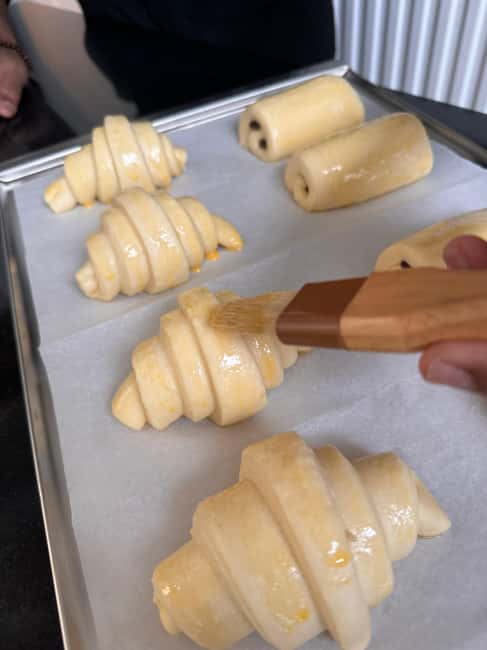
The recipe is included, but the real value is learning how to judge the dough. At home, you may have a different oven, a different work surface, or a different room temperature. The recipe gives you the framework, while the chef’s tips help you adjust.
You learn about the role of butter, the reason for resting, and the effect of proofing. Those details matter more than memorizing a precise number of minutes. A good croissant depends on conditions, and the class gives you a better sense of how to respond when the dough behaves differently.
Several participants have also found the chef’s informal advice useful beyond the recipe. Chef Leo has shared pastry and restaurant suggestions, and both chefs encourage questions throughout the session. This turns the class into a conversation rather than a one-way lesson.
If you bake regularly, you may already know some of the basics. Even then, the class offers value through direct feedback. You can compare your technique with the chef’s method and learn where professional handling differs from home baking.
How much value do you get for $140?
At $140 per person, this is not a cheap way to eat a croissant. You can buy excellent pastries in Paris for a few euros. The price makes sense only if you want the instruction, the kitchen experience, the ingredients, the equipment, and the pastries you make yourself.
For that price, you receive three hours of teaching, all necessary ingredients, professional-grade tools, the recipe, and a generous amount of finished pastry. The small group is important to the value. A larger class could offer the same recipe, but not the same level of individual correction.
The experience also replaces a standard sightseeing block with something active. You are not just consuming a Paris specialty. You are learning why it works and gaining a skill you can try again at home.
I would call the price fair for a visitor who values food experiences and intends to use the recipe later. If you only want to taste a croissant, spend the money at a respected bakery instead. If you want a memorable activity with a useful result, the fee is easier to justify.
Who will enjoy the three-hour format?
This class suits couples, friends, solo visitors, parent and adult child pairs, and families with older teenagers. It has worked well for people with no baking background, as well as keen home bakers who want professional guidance.
It is also a good rainy-morning activity. The work keeps you occupied, and the warm pastries give you a practical reward at the end. You do not need to be a serious cook, but you should be willing to knead, roll, and listen carefully.
The class is less suitable if you have limited arm strength or do not want a physically active food experience. Croissant making is not simply decorating prepared dough. You will need to work the mixture and handle repeated rolling.
The small group can be a strong fit for solo visitors because the class has enough structure to avoid awkwardness. At the same time, it gives couples and families room to enjoy the activity together without being lost in a crowd.
Practical tips for making the class easier
Arrive with enough time to locate the gray storefront at Studio Pâtisserie. Rome and Villiers are the nearest Metro stations, so public transport is straightforward, but you should still allow a buffer before the start.
Wear clothes you can work comfortably in. The class involves flour, butter, kneading, and rolling, and you will be using the kitchen rather than sitting in a lecture.
Come hungry, but not overly hungry. You may produce eight pastries per person, often split between butter croissants and pain au chocolat, and you will want to sample at least one fresh from the oven. Bring a bag or make room in your day for carrying the rest.
Take notes if you want to repeat the recipe. The chefs share small tips about how and why to handle each stage, and one participant wished they had recorded more of the lesson. Recording may not be allowed, so ask first, but a few written reminders can help.
If you prefer a more decorative pastry, check for the bi-colour option on your chosen date. It is offered only on selected days and requires the specific ingredients and format.
Should you book this Paris croissant class?
I would book it if you want a real cooking activity rather than a pastry tasting. The combination of small-group help, clear instruction, warm pastries, and a recipe to take home gives the $140 price a solid purpose.
Chef Leo and Chef Maria bring the kind of friendly energy that helps beginners relax, while the lesson still covers serious technique. The class is especially good for a couple, family group, or food-minded solo visitor looking for a hands-on morning near well-connected Metro stations.
Skip it if you dislike kitchen work, have trouble with rolling dough, or only want a quick bite. For everyone else, this is one of the more useful ways to understand a classic Paris pastry, and you get to eat your homework.
FAQ
How long does the croissant class last?
The class lasts three hours. The schedule includes preparing, rolling, folding, shaping, proofing, and baking the pastries, along with explanations about croissant-making.
How much does the class cost?
The listed price is $140 per person.
Where does the class meet?
The class meets at Studio Pâtisserie, a building with a gray-colored storefront in Paris.
Which Metro stations are closest?
The nearest stations are Rome on Metro Line 2 and Villiers on Metro Line 3.
Is the class taught in English?
Yes. The instructor language is English.
How many people are in the group?
The class is limited to eight participants.
Which pastries will I make?
The standard class includes croissants and pain au chocolat. A bi-colour croissant class is available on selected days if you choose that option.
Is the class suitable for children?
Children under 15 are not permitted. Anyone under 17 must be accompanied by a paying adult.
What is included in the price?
The price includes chef instruction, ingredients, professional kitchen equipment and tools, a recipe to take home, sampling of the pastries you make, and tips about croissant technique.
Newest classes around Paris
- Paris: Traditional Croissant Cooking Class With Local Baker★ 5.0 · 2 reviews
- Paris: The Soufflé Baking Class with Chef★ 4.5 · 2 reviews
- Paris: Millefeuille baking class with a chef★ 5.0 · 5 reviews
- Paris: Lemon Tart Baking Class with a Pastry Chef★ 5.0 · 4 reviews
- Paris: Macaron Baking Class★ 4.4 · 26 reviews
- Paris: Hands-On Small Group Cooking Class★ 4.9 · 19 reviews
- Paris: Evening Cooking Class with Optional Market Visit★ 4.8 · 19 reviews
- Eclair Baking Class with A Pastry Chef★ 5.0 · 3 reviews
Paris Cooking Classes, compared.
Paris Cooking Class and Lunch with Wine plus Market Visit Option
Read our review →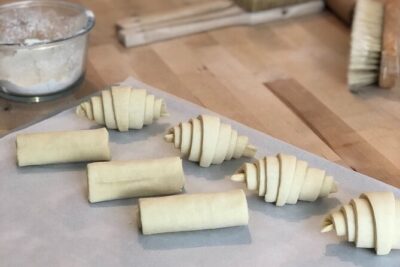
Paris Croissant Small-Group Baking Class with a Chef
Read our review →
Paris Cooking Class: Learn How to Make Macarons
Read our review →
Paris Evening Cooking Class French Dinner and Market Visit Option
Read our review →
Paris French Cuisine Small Group Cooking Class with Lunch
Read our review →
Paris Macarons Small-Group Baking Class with a Chef
Read our review →Browse the lists this tour appears in