
Review · PARIS COOKING CLASSES
Paris: Millefeuille baking class with a chef
The best part of this Paris class is that you do not simply eat a millefeuille, you learn why its layers work. A professional pastry chef guides you through puff pastry, pastry cream, decoration, baking, and assembly, so the famous French dessert becomes a skill you can repeat at home. I especially like the small group of up to eight and the hands-on format, which should leave room for useful questions.
I also like that you take your finished creation home in proper transport packaging, rather than having to eat it quickly at the workshop. The main point to check is timing: the booking details list the class at 150 minutes, while the description calls it a three-hour class. Confirm the exact schedule before you book.
Key points at a glance
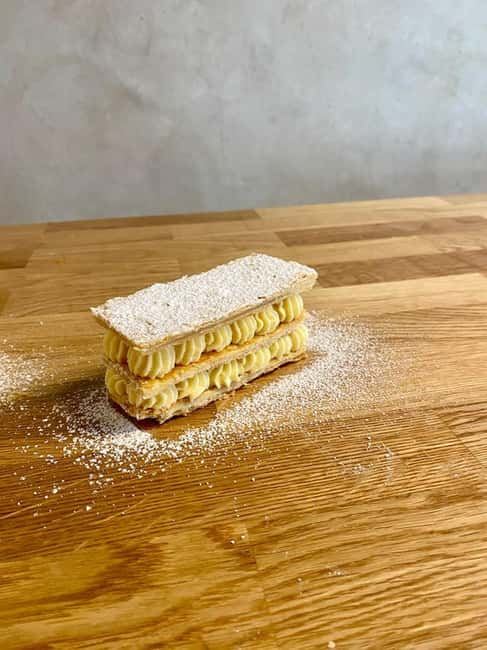
- Make the full dessert from scratch: You work with both puff pastry and pastry cream, not just decoration.
- Learn beside a professional chef: The class is taught in English and suits beginners as well as experienced bakers.
- Keep your own millefeuille: Special transport packaging lets you carry the finished dessert safely.
- Personalize the finish: You can add decorative touches before baking and assembling your pastry.
- Small-group setting: With no more than eight participants, the class should feel more personal than a large demonstration.
- A practical Paris souvenir: Ingredients, drinks, and a digital recipe are included, so you leave with both dessert and technique.
Why millefeuille makes a good Paris cooking class
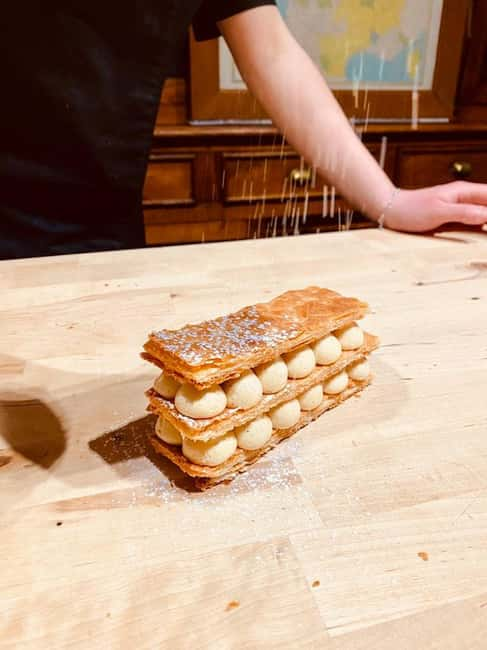
Millefeuille is one of those pastries that looks simple until you try to make it. The classic version layers crisp puff pastry with smooth pastry cream, then finishes the top with a neat decorative surface. Every part matters. The pastry must be flaky but sturdy, the cream must hold its shape, and the final stack must be assembled without crushing the layers.
That makes this more useful than a class focused only on a quick, easy treat. You get a lesson in several core pastry skills at once. Folding dough teaches patience and precision. Pastry cream teaches temperature control and texture. Assembly teaches restraint, since too much filling or pressure can ruin the clean layers.
The dessert is also known as a Napoleon. Its French identity is tied to the work of François Pierre de la Varenne, an important 18th-century French chef associated with its development. You do not need to know the full story to enjoy the class, but that background gives the recipe a little more weight. You are working with a classic that has been part of French pastry culture for centuries.
I like this choice for Paris because the activity connects directly with the food you see in local pâtisseries. Instead of only pointing at the pastry case, you learn what goes into the crisp layers and creamy center. It gives you a better eye for quality when you later buy millefeuille elsewhere in the city.
More Baking Classes in France
- Paris Croissant Small-Group Baking Class with a Chef
★ 5.0 · 910 reviews - Paris: French Croissant Baking Class with a Chef
★ 4.9 · 712 reviews - Paris Macarons Small-Group Baking Class with a Chef
★ 5.0 · 316 reviews
The opening: learning the pastry foundations
The class begins with the ingredients and the basic plan for the dessert. All baking ingredients are provided, so you do not need to shop before arriving or bring specialty equipment from home. That matters in Paris, where a cooking class is much easier to enjoy when you can arrive with only yourself and an appetite.
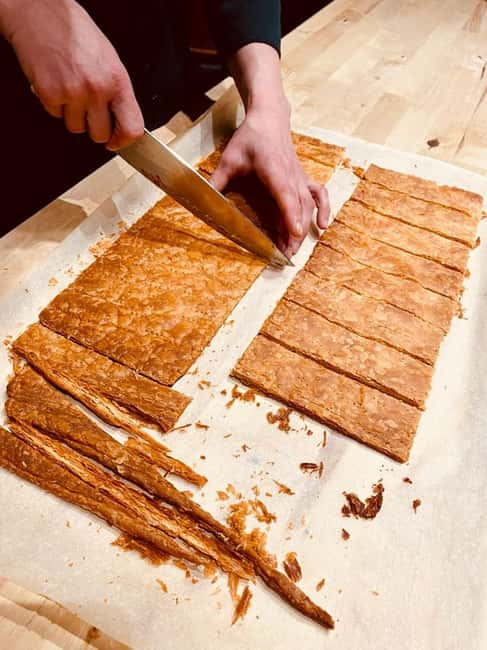
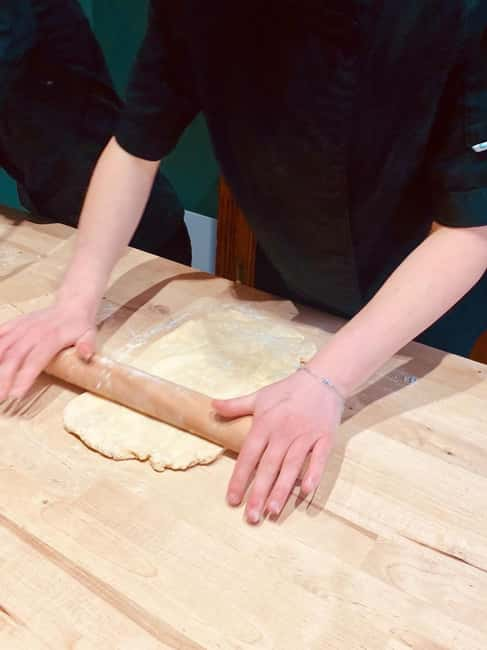
Your chef takes you through the puff pastry process. The supplied information does not give the chef’s name, but the class is taught in English by a professional pastry chef. You can expect instruction on folding the dough and working toward the correct texture, two parts of the recipe that can make or break the result.
Puff pastry requires attention because its layers come from the relationship between dough and butter. If the dough is handled poorly, the finished pastry may be heavy or uneven. If it is shaped with care, it can bake into thin, crisp layers. The point of doing this in class is not simply to copy movements. It is to understand what the dough should feel and look like at each stage.
This is where the small group matters. With a maximum of eight people, you should have a better chance of seeing the chef’s technique and asking about your own dough. That is especially helpful for beginners, who may not know if a texture is correct or if a fold has gone wrong.
The class is also suitable for experienced bakers who want to refine their method. A pastry chef can point out details that are easy to miss in a written recipe, such as how firmly to handle the dough or how to judge consistency by sight.
Pastry cream and the search for the right texture
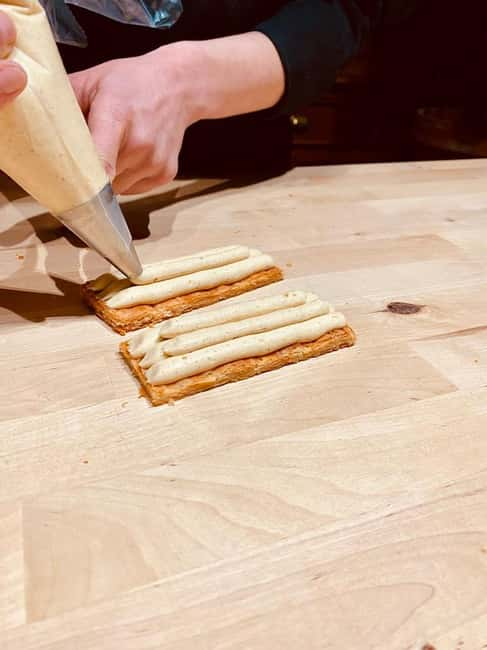
Next comes the silky pastry cream. This filling is not just a sweet layer between sheets of pastry. It needs enough body to hold the millefeuille together, but it should still feel smooth and rich when you eat it.
The chef explains the steps in detail, including how to reach the right texture. That guidance is valuable because pastry cream can change quickly during preparation. A written recipe may tell you what to do, but it cannot watch the mixture with you. In class, you can compare your result with the chef’s and ask questions as you go.
I would pay close attention here, even if puff pastry is the part that first attracted you. Pastry cream is useful beyond millefeuille. You can use the same basic technique in other French desserts, so this portion of the lesson may be one of the most practical skills to take home.
The activity is designed for different skill levels. A first-time baker can follow the chef step by step, while a more practiced baker can focus on small improvements in texture and handling. The format avoids making the class feel like a test. You are there to learn, not to produce a pastry-shop display on your first attempt.
Tea, coffee, and water are available throughout the session. These are simple inclusions, but they help during a class that involves several stages and waiting points. Additional food or drinks outside the workshop are not included.
Decorating your pastry before the final assembly
Once the main components are ready, you have the chance to personalize the millefeuille with decorative touches. This adds a creative part to an otherwise technical lesson.
The decoration is not merely a finishing flourish. It also lets you make the pastry your own, especially if several people in a family or group are attending together. You can focus on a clean, classic look, or use the opportunity to make a more personal design. The exact decorative options are not specified, so you should not expect a fixed list of toppings or artistic tools unless the chef explains them on the day.
The balance is useful: first you learn the rules of the dessert, then you get some freedom. The pastry still needs to be baked and assembled correctly, but the top gives you room to show a little personality.
For children, the decorative stage may be the most immediately entertaining part. For adults who already bake, it provides a chance to work on presentation. Either way, the class is not limited to watching a chef do all the work.
More Baking Classes in Paris
- Paris: Macaron Baking Class for Families and Kids
★ 4.7 · 270 reviews - Paris: Macaron Baking Class in Central Paris
★ 5.0 · 208 reviews - Paris: Croissant Baking Class with a Chef
★ 5.0 · 201 reviews - Paris French Baking Class Baguettes and Croissants in a Bakery
★ 4.5 · 172 reviews
Baking and assembling the finished millefeuille
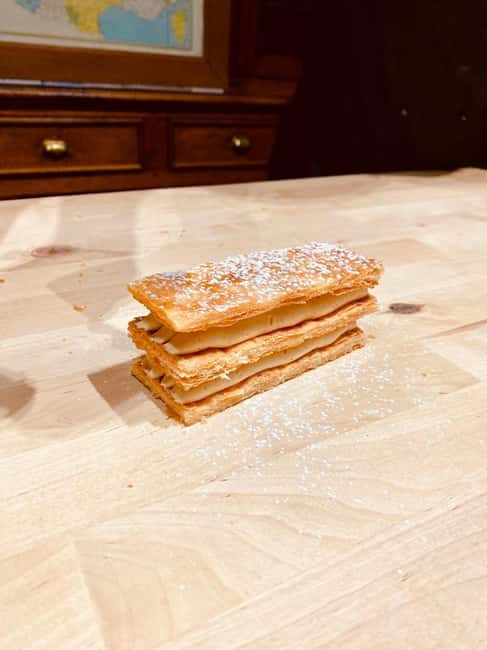
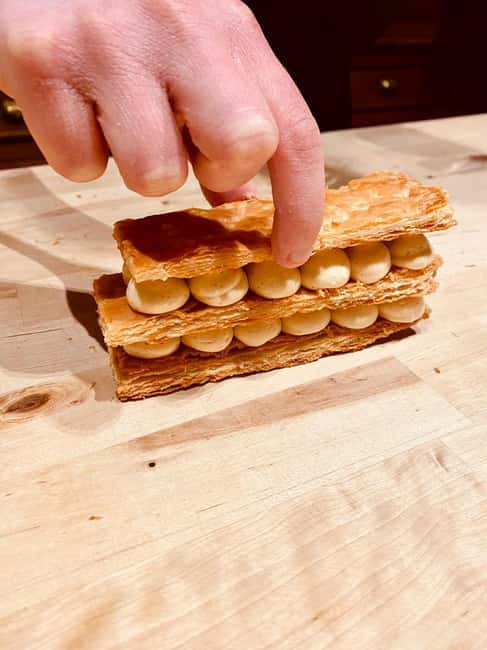
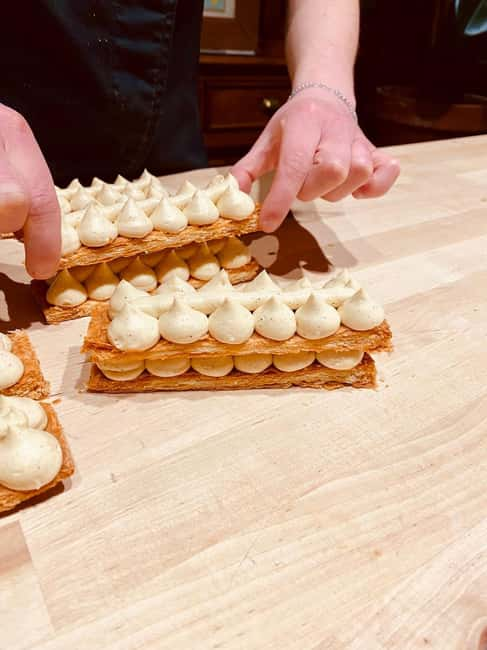
The final stages bring the separate parts together. You work with the baked puff pastry and pastry cream to create the familiar layered dessert. This is where neat handling becomes important. Crisp pastry can break, and cream can squeeze out if the layers are pressed too hard.
The chef guides you through the assembly rather than leaving you to guess. That direct help is one of the strongest reasons to choose a workshop instead of trying to learn from a cookbook alone. You can see how the layers are aligned and how the filling is distributed.
The supplied experience details say you create your own millefeuille, and one participant had a private one-to-one session and made three millefeuilles. That is not a promise for every booking, but it shows that the format can sometimes be tailored closely to the person attending. Standard availability is described as a small group, so ask when booking if you need to know how much individual production time is planned.
The finished dessert is yours to enjoy after the session or take away. Transport packaging is included, which is a practical touch. Millefeuille is delicate, and carrying an unprotected pastry through Paris would be an unnecessary challenge.
What the $159 price includes
At $159 per person, this is not a cheap snack stop. You are paying for an instructor-led pastry lesson, ingredients, the use of the workshop setting, drinks during class, packaging, and a digital recipe.
The value depends on how you use the class. If you only want to eat a millefeuille, a pâtisserie will cost far less. If you want a guided activity and hope to repeat the recipe at home, the price makes more sense. You are paying for instruction and practice, not just the finished dessert.
The small capacity also helps explain the cost. A class limited to eight participants can offer more contact with the chef than a large cooking demonstration. The strongest praise has focused on the chef’s personal approach. One participant described a one-to-one session with a warm and engaging teacher, while another family appreciated the chef’s patience and useful tips. Those details suggest that the human side of the class is a major part of its value.
Still, expectations should be realistic. The supplied information does not name the chef or promise a private session for every booking. Most people should expect a shared workshop, with the amount of individual attention shaped by the group size and the number of pastries being prepared.
A digital recipe is provided, with a print version planned for the future. That means you can refer back to the method after returning home, though you should be comfortable using a digital copy for now.
Who will enjoy this class most
This experience is a good fit if you like food activities with a clear result. You do not need advanced baking skills. The class is intended for novices and experienced bakers, and the chef guides you through each step.
It should work well for:
- Couples looking for a hands-on Paris activity
- Families who enjoy making and eating dessert together
- Home bakers wanting to improve pastry technique
- Visitors who prefer a small workshop to a large group demonstration
- Anyone curious about the work behind classic French pâtisserie
It may be less suitable if you want a fast tasting or a completely relaxed food stop. Puff pastry takes care and attention. You will be handling several stages rather than sitting back while someone else cooks.
The activity is wheelchair accessible, which makes it available to a wider range of visitors. Transportation to the workshop is not included, so you need to make your own way there. The location is in Paris and described as easily accessible, but the exact meeting address and route should be checked before arrival.
Timing, booking, and practical details
The listed duration is 150 minutes, or two and a half hours. The longer description refers to a three-hour class, so allow extra time in your day and confirm the exact start and finish when reserving. Pastry work can also run on a natural rhythm, especially when baking and cooling are involved.
The class is conducted in English. Tea, coffee, and water are available throughout, while any food or drink beyond the workshop is your own responsibility.
You can cancel up to 24 hours before the activity for a full refund. The reserve-now, pay-later option is useful if your Paris schedule is still moving around. It lets you hold a place without paying at the time of booking, subject to the booking terms shown when you reserve.
The maximum group size is eight. That is small enough to feel personal, but it is not the same as a private lesson. If personal attention is your main reason for booking, ask whether a one-to-one or smaller format is available on your chosen date.
My verdict: should you book it?
I would book this class if you want more than a pastry tasting and like the idea of taking a French technique home with you. The strongest reasons are the small group, direct guidance from a professional chef, and the chance to work through both puff pastry and pastry cream.
The class also earns points for practical details. Ingredients are provided, drinks are available, your millefeuille is packaged for transport, and a digital recipe gives you a way to try the dessert again later.
I would pause if your schedule is tight or if you are looking for a very short activity. The timing needs clarification, and the $159 price is high for anyone interested only in eating one pastry. But for a food-focused afternoon in Paris, especially with family or a partner, this offers a real skill, a classic dessert, and a personal souvenir you can carry away.
FAQ
How long does the millefeuille class last?
The activity is listed as lasting 150 minutes. The description also refers to a three-hour class, so confirm the exact duration and schedule before booking.
What will I make during the workshop?
You will make a millefeuille from scratch, including the puff pastry and pastry cream. You will then decorate and assemble the dessert.
Is the class taught in English?
Yes. English is the listed language for the instructor and workshop.
Is the class suitable for beginners?
Yes. The workshop is designed for pastry lovers at all skill levels, including people with no advanced baking experience.
What is the maximum group size?
The class is limited to eight participants.
Are ingredients included?
Yes. All ingredients needed for the workshop are provided.
Can I take my millefeuille home?
Yes. Transport packaging is included so you can carry your finished creation safely.
Are drinks included?
Tea, coffee, and water are available during the class. Additional food or drinks outside the workshop are not included.
Is the activity wheelchair accessible?
Yes. The activity is listed as wheelchair accessible. You are responsible for getting to the workshop because transportation between locations is not provided.
Newest classes around Paris
- Paris: Traditional Croissant Cooking Class With Local Baker★ 5.0 · 2 reviews
- Paris: The Soufflé Baking Class with Chef★ 4.5 · 2 reviews
- Paris: Lemon Tart Baking Class with a Pastry Chef★ 5.0 · 4 reviews
- Paris: Macaron Baking Class★ 4.4 · 26 reviews
- Paris: Hands-On Small Group Cooking Class★ 4.9 · 19 reviews
- Paris: Evening Cooking Class with Optional Market Visit★ 4.8 · 19 reviews
- Eclair Baking Class with A Pastry Chef★ 5.0 · 3 reviews
- Paris: Cooking Class with Ferrandi at Galeries Lafayette★ 4.9 · 15 reviews
Paris Cooking Classes, compared.
Paris Cooking Class and Lunch with Wine plus Market Visit Option
Read our review →
Paris Croissant Small-Group Baking Class with a Chef
Read our review →
Paris Cooking Class: Learn How to Make Macarons
Read our review →
Paris Evening Cooking Class French Dinner and Market Visit Option
Read our review →
Paris French Cuisine Small Group Cooking Class with Lunch
Read our review →
Paris Macarons Small-Group Baking Class with a Chef
Read our review →Browse the lists this tour appears in