
Review · HUE COOKING CLASSES
Hue: Traditional Vietnamese Cooking Class
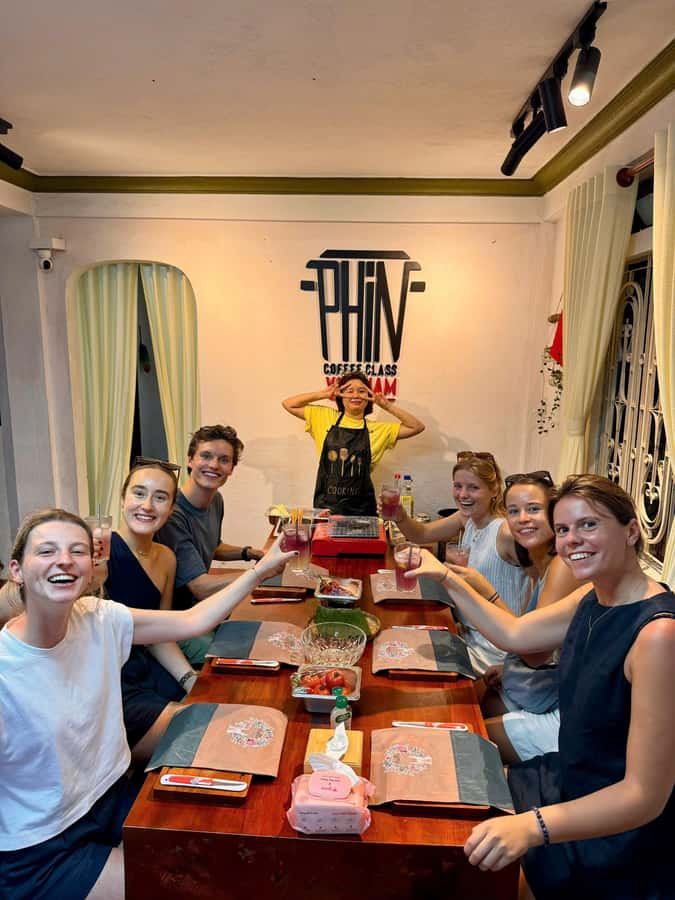
Hue’s food is all about balance, careful seasoning, and small details. This 150-minute cooking class lets you work through five local dishes, from Bun Bo Hue and Banh Xeo to steamed tapioca cakes, then sit down to eat everything you prepared.
I like the small group of up to six, which gives the chef time to answer questions, and I like the choice between vegetarian and non-vegetarian menus. The main drawback is location: you’ll need a short taxi or ride-hailing trip from Hue’s tourist center, then a walk down an alley.
Key points at a glance
- Five Hue dishes from scratch: Cook Bun Bo Hue, Banh Xeo, fresh spring rolls, Banh Bot Loc, seasonal fruit, and royal herbal tea.
- Two complete menus: The vegetarian option uses mushrooms, tofu, mung beans, and vegan sausage instead of meat and seafood.
- Personal instruction: Guides such as Duck, Uyen, and Duc explain cooking methods, local customs, and the differences between Hue food and dishes from other parts of Vietnam.
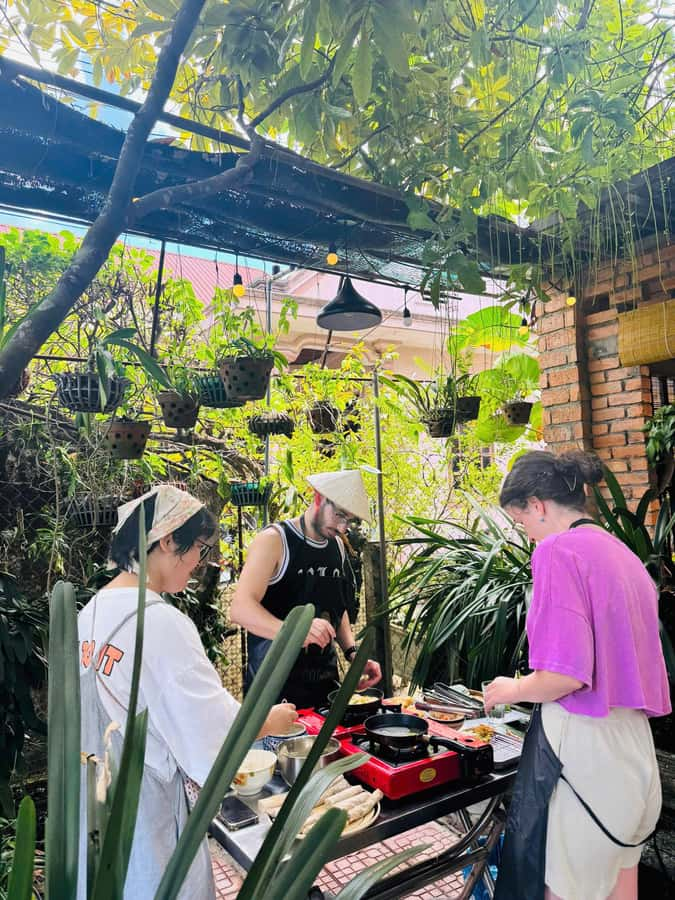
- A quiet garden setting: The class takes place down a small alley on Hoàng Quốc Việt Street, away from the traffic of the main tourist area.
- A proper meal at the end: You eat the dishes you have prepared, with drinking water provided throughout the session.
- Good value at $35: Ingredients, equipment, apron, instruction, tea brewing, recipe card, and the full meal are included.
Why this Hue cooking class is worth your afternoon
I see this class as more than a recipe lesson. It gives you a useful way to understand Hue, a former imperial capital where food has long been tied to presentation, moderation, and careful preparation.
The menu covers several different cooking methods. You’ll make a soup, dumplings, pancakes, rolls, fruit, and tea. That variety matters because you are not spending two and a half hours repeating one simple recipe. Each dish teaches a different part of central Vietnamese cooking.
The class costs $35 per person. For that price, you receive all ingredients, cooking tools, instruction in English, an apron, water, a printed recipe card, and a full meal. You also get the chance to ask about family methods and local variations while you cook.
That is a fair package, especially for a small class. Still, the value depends partly on how much you enjoy hands-on work. This is not a demonstration where you sit back and take notes. You will need to roll, mix, fold, fry, season, and pay attention.
More Vietnamese Classes in Vietnam:
- Cooking Class Hoi An:Local Market, Basket Boat, Fishing & Cooking
★ 5.0 · 3,660 reviews - From Hoi An: Market Tour, Basket Boat Ride and Cooking Class
★ 4.8 · 2,208 reviews - Hoi An: Basket Boat with Lantern-Making & Cooking Class Tour
★ 4.9 · 1,444 reviews
Finding the kitchen on Hoàng Quốc Việt Street
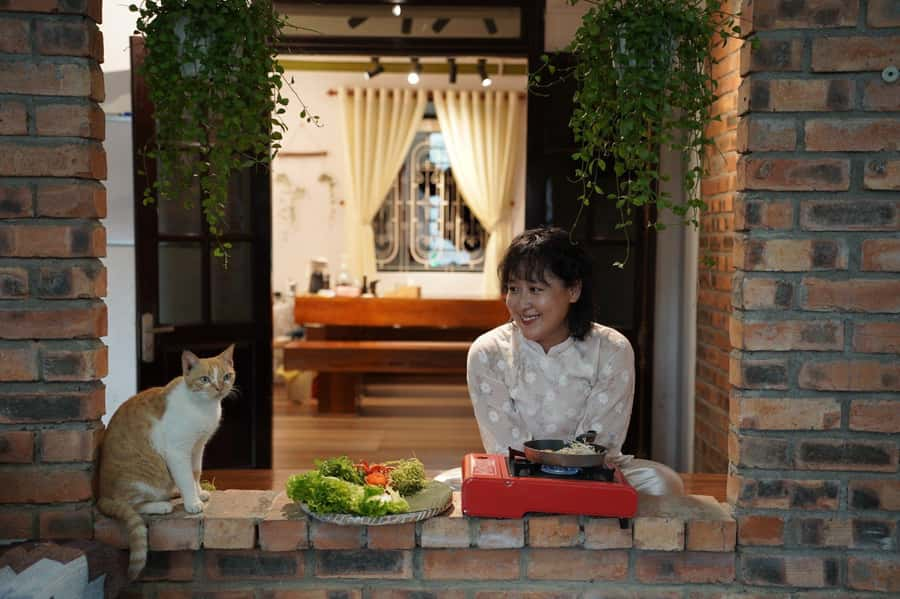
The meeting point is easy to describe but not especially grand. Enter alley number 1 on Hoàng Quốc Việt Street and walk about 50 meters until you see the Huế Experience signboard.
The house sits down a quiet alley with a garden. That setting is part of the charm, but it also means you should allow a little extra time to find the entrance, especially if you are arriving by taxi. The class is a cheap ride from Hue’s main tourist area, according to the practical experience shared by one participant.
I like this location better than a busy commercial cooking school. You get a sense of entering a local home or neighborhood kitchen rather than a polished restaurant classroom. The tradeoff is that the setting may be less obvious from the street.
The activity is listed as wheelchair accessible. If you need specific assistance at the alley entrance or inside the house, it is sensible to confirm the details when booking.
A small group makes the cooking personal
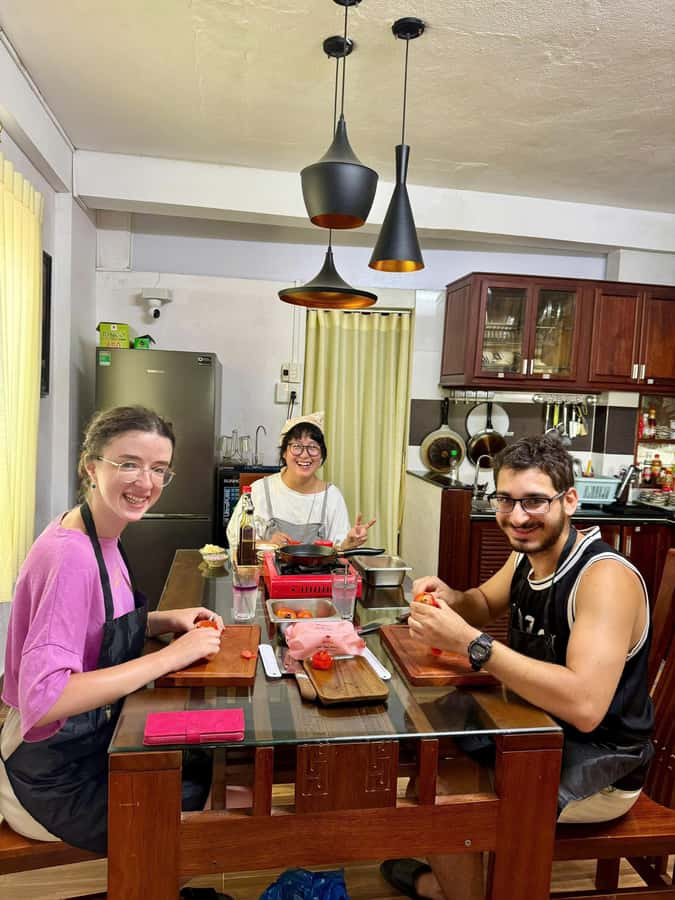
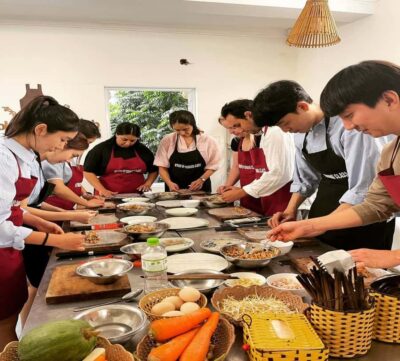
The class is limited to six participants. That number gives it a more personal feel than a large workshop, and it matters when you are learning tasks that require close guidance.
You might need help getting the consistency of a batter right, sealing a dumpling, or adjusting a dipping sauce. With only a few people, the chef can move between workstations and correct small mistakes before they become large ones.
The instructors speak English and have been described as warm, funny, and easy to work with. Duck has led classes with clear explanations and cultural background. Uyen, also identified in one account as Duc, has been praised for explaining how Hue cooking differs from food in other parts of Vietnam.
The teaching style appears relaxed rather than formal. You will learn practical techniques, but you will also hear stories about the dishes, family recipes, and the role of balance in central Vietnamese cuisine.
If you are shy about cooking in front of other people, the small group helps. If only two people book a session, the class may feel almost private. That happened for several participants, though you should not assume every departure will be private.
Bun Bo Hue gives the class its central flavor
Bun Bo Hue is the dish most closely tied to the city, and it anchors the menu. The non-vegetarian version is a spicy beef noodle soup served with fresh herbs.
This is a useful dish to learn because it brings together several basic ideas in Vietnamese food: a seasoned broth, noodles, meat, herbs, heat, and the contrast between warm soup and fresh toppings. The chef can explain how the Hue version differs from noodle soups found elsewhere in Vietnam.
The vegetarian version uses a mushroom broth with tofu and vegan sausage. That is not simply a side dish added for convenience. It gives plant-based diners a full bowl with its own texture and savory character.
You should expect Bun Bo Hue to take a fair share of the class’s attention. Soup depends on seasoning and balance, so the chef will likely explain how the parts work together. The food is served later with the rest of your meal, so pace yourself when you begin tasting.
More Cooking Classes in Vietnam:
- Hanoi Cooking Class: Culture, Local Market & Meaning CSR Impact
★ 5.0 · 5,147 reviews - 5 Traditional Dishes Hanoi Cooking Class with Market Trip
★ 5.0 · 4,890 reviews - Hoi An Cooking Class(Market,BasketBoat Crabfishing&Cooking Class)
★ 5.0 · 3,386 reviews - Cai Be Mekong Delta Tour: Cooking Class, Cycling & Craft Villages
★ 5.0 · 1,881 reviews
Banh Bot Loc shows off Hue’s delicate side
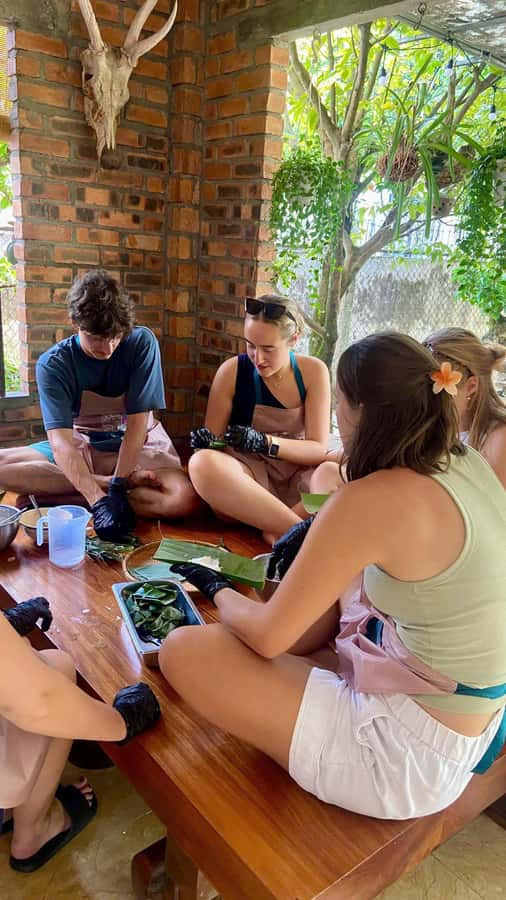
Banh Bot Loc are chewy tapioca dumplings traditionally filled with shrimp and pork, then steamed in banana leaves. The dumplings are small, but they require care. The dough, filling, folding, and steaming all affect the final result.
The banana leaves add more than visual appeal. They are part of the traditional presentation and help frame the dish as something distinctly Hue. You will also learn the vegetarian version, Banh Bot Loc Chay, filled with wood ear mushrooms and mung beans.
This dish gives the menu a different feel from the soup and pancake. It is softer, chewier, and more focused on shaping and steaming. If you enjoy working with your hands, this may be one of the most satisfying parts of the class.
Do not expect every dumpling to look perfect on your first attempt. That is normal. The point is to understand the method well enough to try again at home, using the printed recipe card as a guide.
Banh Xeo brings the sizzle
Banh Xeo are crisp Vietnamese pancakes filled with shrimp and pork, then served with herbs and dipping sauce. The vegetarian version replaces the meat and seafood with mushrooms, bean sprouts, and carrots, along with a vegan dipping sauce.
This is likely to be one of the most active parts of the session. You will work with batter, filling, heat, and timing. The pancake needs to become crisp without losing its shape, and the herbs and sauce provide the fresh, sharp contrast that keeps it from feeling heavy.
One participant particularly enjoyed the extra-crispy version. That detail is useful because texture is a major part of the dish. If you prefer a soft pancake, tell the chef. If you like a firm, crackly edge, pay close attention to the cooking time and ask how to repeat it at home.
Banh Xeo is also a good dish for learning how Vietnamese meals are assembled. You do not simply eat the pancake alone. Herbs, vegetables, and dipping sauce change each bite.
Fresh rolls teach balance without a frying pan
The fresh spring rolls use pork and shrimp in the standard menu, with tofu and vegetables in the vegetarian version. Unlike Banh Xeo, these rolls are not about crispness or heat. They are about fresh ingredients, soft wrappers, and neat assembly.
Rolling is easier to understand than to master. A wrapper that is too dry can crack, while one that is too wet becomes difficult to handle. The chef can show you how to place the filling and tighten the roll without tearing it.
This is one of the most useful recipes to take home because you can change the filling based on what you have available. The class keeps the lesson tied to Hue by using traditional ingredients and sauces, but the basic technique is practical far beyond Vietnam.
The rolls also create a nice contrast with the richer soup and fried pancake. Vietnamese cooking often depends on this kind of balance, with fresh herbs and vegetables working beside cooked and seasoned foods.
Fruit and royal tea slow down the meal
The seasonal fruit plate is simple, but it has a purpose. After several savory dishes, fresh fruit gives you a lighter finish and lets the meal follow the rhythm of a Vietnamese table.
The final drink is Hue royal herbal tea, a fragrant, soothing blend linked to imperial traditions. You will learn how to brew it rather than simply receive a cup at the end.
The tea session adds a cultural layer without turning the class into a history lecture. It shows how food and drink can carry ideas about health, ceremony, and daily comfort. Candied ginger may also be served at the end, as one participant specifically noted.
This is a pleasant time to ask questions. You can talk about the recipes, the ingredients used in Hue, or the differences between the vegetarian and non-vegetarian versions while enjoying the garden setting.
Sitting down to eat what you made
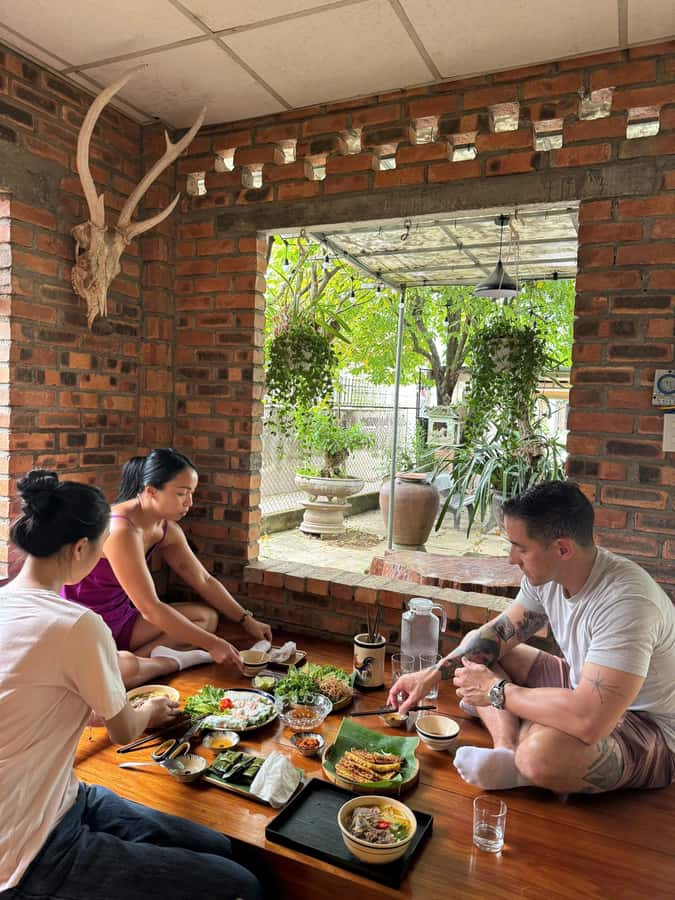
After the cooking is finished, you sit in the garden area and eat the dishes prepared during the class. That final meal is important. You get to see how the separate parts work together rather than judging each recipe in isolation.
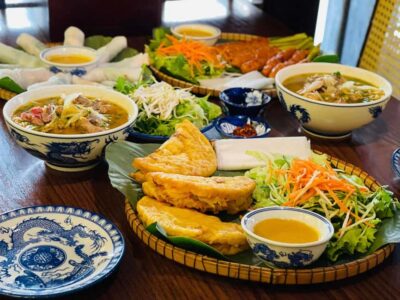
The menu is generous for a 150-minute session: soup, dumplings, spring rolls, pancakes, fruit, and tea. You are likely to leave well fed, so plan the class as a substantial meal rather than a small snack before dinner.
I also like that the meal gives you a chance to compare textures. The chewy dumplings, crisp Banh Xeo, fresh rolls, warm noodle soup, fruit, and tea cover a wide range of flavors and sensations.
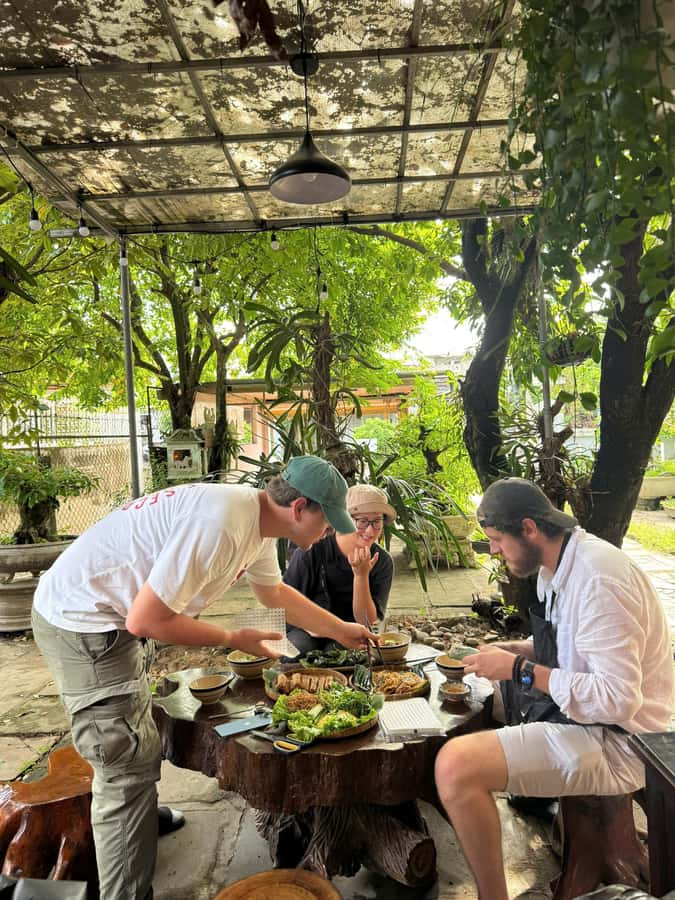
The garden setting adds calm after the work. It is not a large restaurant dining room, and that is the point. You can sit with your small group, enjoy the food, and finish the class at an unhurried pace.
Vegetarian diners get a real menu
The vegetarian program is one of the strongest features here. You receive a full menu, not a meat-free version of only one or two dishes.
Your meal includes vegetarian Bun Bo Hue with mushroom broth, tofu, and vegan sausage. Banh Bot Loc Chay uses wood ear mushrooms and mung beans. Fresh rolls contain tofu and vegetables, while Banh Xeo includes mushrooms, bean sprouts, and carrots.
The sauces are also adapted for the vegetarian menu. That matters because dipping sauce carries much of the flavor in dishes such as spring rolls and Banh Xeo.
You should select your menu when booking or confirm it in advance. The supplied information supports both choices, but it does not specify how the kitchen handles other allergies or dietary restrictions.
What the $35 price really covers
At $35, this is not the cheapest way to eat in Hue. Local street food will cost far less, and you can order many of these dishes without taking a class.
The price makes sense if you value instruction and participation. You are paying for five recipes, food preparation, equipment, an English-speaking chef, a small group, tea brewing, the meal, an apron, water, and a recipe card.
The small group is the key value. In a large class, you may spend much of your time watching someone else. Here, you can expect to take an active role and ask questions about seasoning, folding, frying, and local customs.
The recipe card also gives the experience some value after you leave Hue. You may not recreate every dish exactly at home, especially if ingredients are hard to find, but you will have a starting point and a better understanding of the techniques.
Who should book this class
I would recommend it to food lovers, curious first-time visitors to Vietnam, couples, solo diners, and anyone who wants a break from temple and museum visits. The class is especially useful if you want to understand what makes Hue food different from the food served in Hanoi or Ho Chi Minh City.
It also suits vegetarians unusually well because the alternative menu is detailed and varied. Families may enjoy the hands-on format, though the supplied information does not give a minimum age, so check before booking with young children.
You should be comfortable with a busy cooking session. The chef prepares the ingredients in advance, but you still take part in the cooking. If you want a passive demonstration, this is the wrong format.
The class is conducted in English. The group limit is six, and free cancellation is available up to 24 hours before the activity for a full refund. You can also reserve now and pay later, which helps if your Hue schedule is still shifting.
Should you book the Hue cooking class?
Book it if you want to eat Hue food and understand how it is made, not just take a quick cooking demonstration. The combination of Bun Bo Hue, Banh Bot Loc, Banh Xeo, fresh rolls, seasonal fruit, and royal tea gives you a broad taste of the region in one sitting.
I would be most likely to choose this class for the small group, the full vegetarian menu, and the quiet garden setting. Keep in mind the short ride from the center and the fact that you will be working for your meal.
At $35, it is a strong choice for an interactive afternoon with a local chef. If your main goal is simply to eat cheaply, visit a market or local noodle shop instead. If you want recipes, cultural context, and a meal you helped create, this class earns its place on a Hue itinerary.
FAQ
How long does the Hue cooking class last?
The class lasts 150 minutes, or two and a half hours.
How much does the cooking class cost?
The price is $35 per person.
How many dishes will I cook?
You will prepare five traditional dishes, plus seasonal fruit and one royal herbal tea.
Is there a vegetarian menu?
Yes. The vegetarian menu includes vegetarian Bun Bo Hue, Banh Bot Loc Chay, tofu and vegetable fresh rolls, vegetarian Banh Xeo, seasonal fruit, and royal herbal tea.
Where is the meeting point?
Enter alley number 1 on Hoàng Quốc Việt Street and walk about 50 meters. The Huế Experience signboard marks the meeting point.
Is the class taught in English?
Yes. The instructor language is English.
How large is the group?
The class is limited to six participants.
Can I cancel or pay later?
You can cancel up to 24 hours in advance for a full refund. Reserve now and pay later is also available.
Newest classes around Vietnam
- Can Tho Cooking Class in the countryside – Vegetarian available★ 5.0 · 10 reviews
- Full-Day Experience in Mekong Cycling and Authentic Home Cooking★ 5.0 · 89 reviews
- Biking and Cooking Class in Can Tho Rural★ 5.0 · 5 reviews
- Cooking, Farming and Waterfall In Vietnam Countryside★ 3.0 · 6 reviews
- Cooking class & Vibrant Market by Scooter/Tuktuk (Half-Day)★ 5.0 · 55 reviews
- Top Home Cooking Class with Stunning River View AC Kitchen★ 5.0 · 25 reviews
- Tam Coc Cooking Class with Unique Experience★ 4.3 · 13 reviews
- Street Food Walking Tour with a Cooking Instructor★ 5.0 · 5 reviews
Hue Cooking Classes, compared.
Hue City: Cyclo, Market Tour & Cooking Class at Madam Thu
Read our review →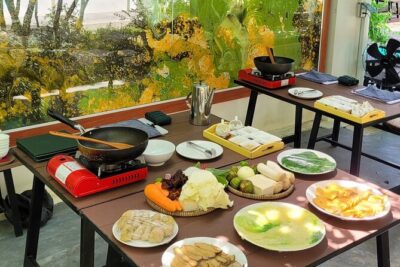
Hue’s Vegetarian Cooking Class in Ancient Garden
Read our review →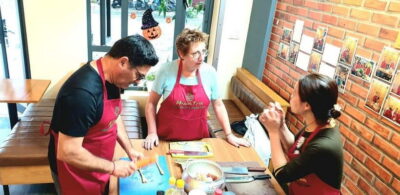
Vietnamese Cooking Class with Local Family in Hue
Read our review →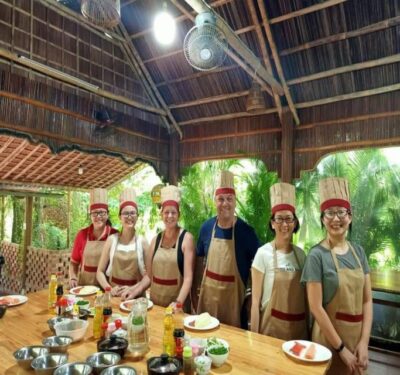
Vietnamese Cooking Class in Local Home & Market trip
Read our review →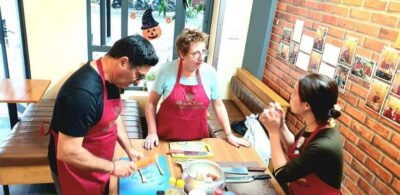
Home Vegan/Vegetarian Cooking Class with Local Girl
Read our review →
Hue Cooking Class with local-Visit market, cook local food
Read our review →Browse the lists this tour appears in